
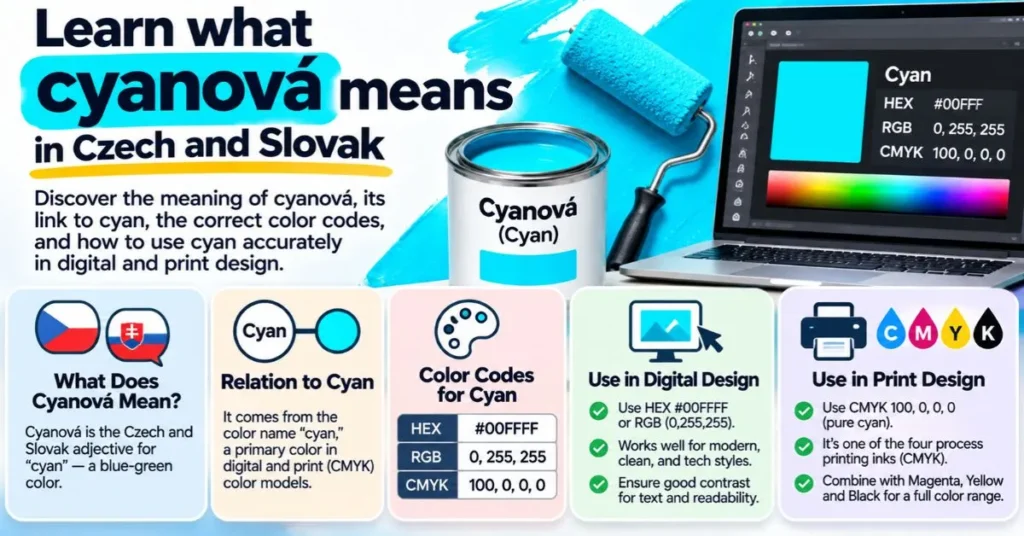
Cyanová is a Czech and Slovak color adjective related to cyan, the vivid blue-green color used in digital graphics, photography and four-color printing. The accented word is not the official name of a newly discovered pigment, a design movement or one exclusive branded shade. It is primarily a grammatical form.
In phrases such as cyanová barva in Czech or cyanová farba in Slovak, the adjective takes a feminine ending because the nouns for “color” are feminine. An English translation can be as simple as “cyan,” “cyan-colored” or “cyan color,” depending on the sentence.
Pure cyan in the standard sRGB web-color system is #00FFFF, or rgb(0, 255, 255). That useful technical reference does not mean every object described as cyanová must match that exact luminous screen color. Context, material, lighting, ink, color profile and the speaker’s intended shade all affect the result.
Cyanová meaning at a glance
| Question | Short answer |
|---|---|
| What does cyanová mean? | Cyan or cyan-colored in feminine grammatical form |
| Which languages use it? | Czech and Slovak |
| Is it a new color? | No |
| Is it a separate international standard? | No |
| Is there one mandatory HEX code? | No, although pure web cyan is #00FFFF |
| What is pure cyan in RGB? | rgb(0, 255, 255) |
| What is cyan in HSL? | hsl(180, 100%, 50%) for the pure sRGB value |
| What does C mean in CMYK? | Cyan process ink |
| Is cyan the same as teal? | No; teal is darker |
| Is cyan the same as turquoise? | Not exactly; the names overlap in casual use but are not interchangeable standards |
The safest way to understand cyanová is to separate language from color specification. The word describes a color family or attribute. A numeric value defines the exact digital color required for a project.
What does cyanová mean?
Cyanová means cyan or cyan-colored when it modifies a feminine noun in Czech or Slovak. It is an adjective, not normally a standalone English technical term.
For example, the Czech phrase “cyanová barva” and the Slovak phrase “cyanová farba” both refer to a cyan color. The different spelling of the noun reflects the two languages, while the adjective can appear in the same feminine form.
English does not usually change a color adjective to match grammatical gender. English speakers say “a cyan color,” “a cyan line” and “a cyan background” without changing the word cyan. Czech and Slovak grammar work differently, which explains the -ová ending.
This linguistic detail is the key to the keyword. Without it, the accent and ending can make cyanová look like a brand, a surname or a newly coined aesthetic label. In documented Czech and Slovak material, it functions as ordinary descriptive vocabulary.
Why does cyanová end in -ová?
Czech and Slovak adjectives agree with the nouns they describe. Their forms can change for grammatical gender, number and case.
In the nominative singular, the relevant forms are commonly:
- cyanový for a masculine noun;
- cyanová for a feminine noun;
- cyanové for a neuter noun.
The noun for color is feminine: barva in Czech and farba in Slovak. The adjective therefore appears as cyanová when used with it.
The ending does not add a hidden meaning such as “soft cyan,” “luxury cyan” or “female cyan.” It marks grammatical agreement. Other endings can appear when the sentence changes case or number, so a learner may encounter forms beyond the three basic examples.
How is cyanová pronounced?
An approximate English guide is “tsee-ah-no-vaah.” The exact sound differs from a casual English reading of cyan.
The final á is a long vowel. It should not be ignored when reproducing the word accurately. The accent mark is part of the spelling, not decoration.
Pronunciation guides written with English letters are always approximate. Czech and Slovak speakers may produce individual consonants and vowel lengths differently from an English speaker. For language learning or public narration, a native audio example is more reliable than a simplified phonetic hint.
Is cyanová a real word?
Yes. It appears in Czech and Slovak technical, educational and descriptive writing. University material, color explanations and other documents use the term in the ordinary sense of cyan-colored.
Calling it a real word does not make it the name of a separate international color standard. The language form is real; exaggerated claims about a unique pigment, inventor or cultural movement are not supported by the evidence reviewed for this article.
Some recent English-language pages capitalize Cyanová and treat it like a proper noun. Normal Czech and Slovak usage does not require capitalization unless the word begins a sentence, appears in a title or is deliberately used as a brand name.
Is cyanová a newly invented color?
No. The underlying color is cyan, which has a long-established role in color science, printing, photography and computing. Cyanová is a grammatical form used to describe that color.
There is no recognized announcement of a new color called Cyanová, no single inventor and no standards organization that defines it as a separate hue. Claims that it emerged as a 2026 art movement or futuristic lifestyle concept appear to be unsupported embellishments.
A designer is free to use Cyanová as the title of a palette or creative project. That private naming choice does not create a universal specification. Anyone receiving such a design should still ask for the actual values or approved color sample.
What color is cyan?
Cyan is a vivid color between green and blue. On an RGB screen, the pure standard value is produced with full green and full blue light and no red light.
The result is bright because it is emitted by the display. On the familiar hue circle used by digital design tools, pure cyan is located at 180 degrees, between green at 120 degrees and blue at 240 degrees.
People may describe cyan as blue-green, greenish blue, aqua-like or turquoise-like. Those descriptions help with recognition but do not make the names technically identical. Color naming varies by language, culture, product category and individual perception.
What is the official cyan HEX code?
For standard web color, cyan is:
- HEX:
#00FFFF - RGB:
rgb(0, 255, 255) - HSL:
hsl(180, 100%, 50%) - HSV: 180 degrees, 100 percent saturation, 100 percent value
The World Wide Web Consortium lists cyan as the same sRGB color as the CSS keyword aqua. Both produce #00FFFF in CSS.
This is an official mapping for the CSS named color, not proof that the word cyanová always means exactly #00FFFF. A sentence can describe a material or line as cyanová even when its measured appearance is darker, less saturated or shifted slightly toward blue or green.
Does cyanová have one official color code?
No. Cyanová itself is a language form, not a separate entry in a universal color registry. It has no independent mandatory HEX, RGB, CMYK, Pantone or RAL value.
Using #00FFFF is reasonable when a project asks for pure digital cyan. A softer interface accent might use a darker or less saturated variant. A printer may use process cyan ink or a spot-color reference selected for the material.
The name alone is insufficient when consistency matters. A brand guide should record the target values, color space, profile, substrate and approved physical sample where appropriate.
Why do websites give different cyanová codes?
Different codes usually result from one of four issues.
First, some pages simply map cyanová to pure web cyan, #00FFFF. Second, others use “process cyan,” a print-related approximation displayed on a screen. Third, creative articles treat the word as a broad mood and choose turquoise, aqua or teal variants. Fourth, some databases attach multiple English color names to similar coordinates.
One Slovak color database, for example, labels both #00FFFF and #00B7EB with cyan-related wording in different entries. That is evidence of naming variation, not proof that the two values are equal.
When two sources disagree, identify the intended medium and use the numeric value. Do not try to resolve a technical color conflict through the name alone.
Cyan in RGB screens
RGB is an additive color model used for displays. Red, green and blue light are mixed at different intensities. Adding all three at maximum produces white; switching them all off produces black.
Pure cyan uses zero red with maximum green and blue. The screen emits the two channels simultaneously, creating a bright blue-green appearance.
Even identical RGB numbers may not look identical on every device. Display calibration, brightness, viewing mode, ambient light, panel technology and color management influence perception. Screens in vivid mode often make cyan look more intense than a calibrated professional monitor.
For ordinary web design, sRGB is the safest baseline. For controlled photography or wide-gamut production, the chosen color space should be communicated explicitly rather than assuming every application interprets numbers in the same way.
Cyan in CMYK printing
CMYK is a subtractive print model built around cyan, magenta, yellow and black inks. Cyan is the C in the name.
Ink does not emit light. It absorbs parts of the light falling on paper and reflects what remains toward the viewer. This is why a brilliant #00FFFF display color cannot be guaranteed to reproduce with the same luminous intensity in ordinary process printing.
A simplistic conversion may describe pure cyan as C=100, M=0, Y=0, K=0. Real production values depend on the press, ink set, paper, color profile and desired result. Coated paper, uncoated paper, fabric and packaging can all change the appearance.
Designers should convert through the printer’s recommended ICC profile, request a proof and avoid judging a final print solely from an uncalibrated monitor.
Is process cyan the same as screen cyan?
They play related roles but are not physically the same thing. Screen cyan is light created through green and blue RGB channels. Process cyan is ink used in subtractive printing.
The screen version can appear extremely bright because the display produces light. Ink depends on illumination and the reflecting surface. Some screen colors fall outside the range a particular CMYK process can reproduce.
Pantone also publishes a Process Cyan reference, but a monitor simulation is not a substitute for a physical Pantone guide. Pantone itself warns that computer simulations may not match identified standards.
For a brand that uses cyan heavily, the practical solution is to define separate approved values for screen, process print and any spot-color workflow, then compare real output.
Cyanová compared with aqua
In CSS, the keywords cyan and aqua are exact synonyms. Both resolve to #00FFFF.
Outside CSS, people may use aqua more loosely for watery, lighter or slightly greener blue shades. Paint, clothing and cosmetics brands can assign their own names. Therefore, two products called aqua and cyan are not guaranteed to match.
The technical equality applies to the standardized CSS keywords. Product names and conversational descriptions are less controlled.
Cyanová compared with turquoise
Turquoise usually refers to a family of blue-green colors and also to the mineral that inspired the name. It often appears more muted, greener or less electrically bright than pure digital cyan.
There is no single everyday turquoise that covers every product. Web CSS does define a keyword called turquoise, but that is a specific coding value rather than a rule for every paint or fabric carrying the name.
Cyan and turquoise can be visually close. When exact matching matters, compare codes or physical samples rather than assuming the names are interchangeable.
Cyanová compared with teal
Teal is significantly darker than pure cyan in the standard CSS palette. CSS teal is #008080, while CSS cyan is #00FFFF.
Both sit in the blue-green region, but teal has lower channel values and therefore a much darker appearance. Teal can support light text more effectively in some layouts, while bright cyan normally requires very dark text for readability.
Calling every blue-green shade cyanová would hide useful differences. Designers should use the precise name and value relevant to the chosen palette.
Cyanová compared with azure
Azure is commonly associated with a bright sky-blue range. It generally leans more toward blue than pure cyan. Language adds another complication because Czech and Slovak sources may use words related to azurová or azúrová when translating or explaining cyan.
CSS has an azure keyword, but it is a very pale color, #F0FFFF, not the saturated blue often imagined from the ordinary word azure. This is a good example of why standardized code names and everyday color language can diverge.
An article should avoid claiming that cyan, cyanová and azure are always identical. They may overlap in translation or informal description, while technical systems distinguish them.
The origin of the word cyan
The English color name cyan ultimately traces to the Greek word kyanos or kyaneos, associated with dark blue or blue substances. The term traveled through scientific and language history before becoming familiar in modern color systems.
Cyanová combines this established color root with Czech or Slovak adjective morphology. The final form is therefore not evidence of a newly coined English word.
Etymology does not define a modern color coordinate by itself. An ancient word could refer broadly to a dark blue appearance, while present-day digital cyan has an exact sRGB definition. Historical meaning and current technical use should be kept separate.
How designers can use cyan effectively
Cyan works well as an accent when a design needs freshness, clarity or high visual energy. It is common in technology interfaces, water-related themes, scientific graphics, lighting effects and modern promotional art.
Practical uses include:
- interface highlights on a dark background;
- chart series combined with labels and patterns;
- gradients moving from blue through cyan to green;
- photography treatments and duotone effects;
- packaging accents where a proof confirms print behavior;
- motion graphics and luminous screen effects;
- icons, borders and calls to action when contrast is sufficient.
The color should support the content rather than substitute for hierarchy. A page filled with equally bright cyan elements can become visually tiring and make the important action harder to find.
Which colors work with cyan?
Useful combinations depend on the desired effect.
Dark navy, charcoal and near-black backgrounds make bright cyan appear luminous. White and light gray can produce a clean palette, but cyan details may need a darker shade to remain visible. Blue and green create an analogous family with smooth transitions. Orange, coral and red-orange can provide strong warm contrast.
A palette should not be chosen from theory alone. Test the actual text sizes, images, components and output medium. Complementary colors can attract attention but become harsh when both are fully saturated and used in equal amounts.
For a balanced interface, one approach is to use a dark neutral as the main background, off-white for body text and cyan for limited interactive accents. The exact values must still be contrast-tested.
Accessibility and cyan text
Pure cyan is extremely light in relative-luminance terms. White text on a #00FFFF background has very poor contrast. Black or a sufficiently dark navy is a more sensible starting point.
Web Content Accessibility Guidelines require a contrast ratio of at least 4.5:1 for normal text and 3:1 for large text at Level AA, subject to defined exceptions. Designers should measure the exact foreground and background combination rather than judge it by eye.
Color must not be the only way information is communicated. If cyan means “selected,” “safe” or “active,” add another cue such as text, an icon, an underline, a border or a change in shape. This helps people with color-vision differences and users viewing content under difficult lighting.
Using cyan in charts and data visualization
Cyan can be effective in charts, especially on dark backgrounds, but it should not carry meaning alone.
Label lines directly where possible. Use patterns, marker shapes or line styles when multiple series are compared. Make sure neighboring colors differ in lightness as well as hue. Provide a text summary for essential conclusions.
A legend that says only “the cyan line improved” can fail if a reader cannot distinguish that color. Naming the series and describing the trend makes the graphic understandable beyond the palette.
Avoid placing thin bright cyan lines on white. They may look energetic on one monitor but disappear on another screen or in a projector presentation.
Using cyan in branding
Cyan can signal a modern, energetic or clean visual direction, but color psychology is not a universal law. Meaning changes with industry, culture, neighboring colors and brand experience.
A successful identity needs more than an emotional claim about a hue. It requires consistent values, typography, spacing, imagery and usage rules. The brand guide should document:
- primary digital values;
- print conversions and profiles;
- approved spot references if used;
- minimum contrast combinations;
- acceptable tints and darker variants;
- prohibited background combinations;
- proofing requirements for important materials.
If the brand name itself is Cyanová, trademark and domain questions must be evaluated separately. The language meaning does not prove that one company owns the name globally.
Using cyan in interiors and products
Screens are a poor sole reference for choosing paint, fabric or plastic. Physical materials reflect light, and their appearance changes through the day.
Test a sample in the real room or product environment. Observe it under daylight and artificial lighting. Compare it with flooring, metals, wood, white surfaces and other blue-green elements.
Highly saturated cyan can be powerful in a small accent and overwhelming across a large wall. Softer tints may feel more comfortable in broad areas, while deeper teal-like variants can provide weight. These are design judgments, not a universal psychological formula.
Manufacturers may use imaginative names that include cyan without matching #00FFFF. Always choose from the physical sample or technical specification supplied for that product.
How to specify cyanová correctly in a project
Start by asking where the color will appear.
For a website, record the CSS value and color space. For an app, include component states and dark-mode behavior. For print, specify the CMYK profile or spot reference and request a proof. For textiles and manufacturing, use the supplier’s approved swatch or laboratory target.
A concise handoff might state that the word cyanová is the descriptive label while the approved digital value is a particular HEX code. That prevents another designer from choosing a different blue-green merely because the name seems close.
Also preserve the accent if the Czech or Slovak spelling matters. Cyanova without the accent may be necessary in a URL or system that rejects diacritics, but it is not the exact same written form.
Cyanová and Cyanova are not always the same
Cyanová with á is the language form discussed in this article. Cyanova without the accent can be a simplified search spelling, username, product name or brand.
Search engines may merge results because users often omit diacritics. That does not prove that every unaccented company or account has a relationship with the Czech or Slovak adjective.
If the word appears as a company name, verify that specific entity. If it appears beside RGB, CMYK, paint or design, the color meaning is more likely. If it appears in a sentence with a feminine Czech or Slovak noun, it is probably grammatical agreement.
Does cyanová refer to a person or surname?
The -ová ending often appears in feminine Czech and Slovak surnames, so an English reader may reasonably wonder whether Cyanová is a family name.
In color-related usage, the ending belongs to the adjective and should not be turned into a fictional biography. No reliable evidence reviewed for this article establishes a widely documented public figure known simply as Cyanová.
A username or private surname may still exist. A real person should only be identified through reliable context, not through the appearance of the ending alone.
Common myths about cyanová
One myth says Cyanová is a new color discovered recently. It is not; the evidence points to a grammatical form of cyan.
Another says it has one secret or premium HEX code. It does not. Pure web cyan is #00FFFF, but cyanová does not impose that value in every context.
A third presents it as an artistic philosophy or cultural movement. No credible institution, manifesto or documented history reviewed here supports that claim.
A fourth assigns fixed psychological effects such as guaranteed calm, creativity or productivity. Color can influence design experience, but such promises ignore context and individual differences.
A fifth claims that digital and printed cyan will automatically match. They use different physical models and need color management and proofing.
How to verify color claims online
Look for the authority behind the claim. Web-color values should align with CSS specifications. Printing advice should come from recognized design documentation, printers or color-management standards. Language claims should be supported by actual usage and grammar rather than repetition across SEO blogs.
Watch for signs of weak content:
- no distinction between a word and a color standard;
- invented origin stories without dated sources;
- one universal Pantone or RAL number presented without evidence;
- claims that a shade guarantees an emotion or business result;
- identical passages repeated across unrelated websites;
- a fictional founder, movement or celebrity attached to the keyword;
- digital values treated as exact print recipes.
The more precise a claim is, the more precise its evidence should be.
Conclusion
Cyanová is best understood as the feminine Czech and Slovak adjective for cyan or cyan-colored. Its ending reflects grammar, especially in phrases such as cyanová barva or cyanová farba. It is not a separate pigment, new color discovery or independently standardized design movement.
For digital work, pure CSS cyan is #00FFFF, equivalent to rgb(0, 255, 255) and the CSS keyword aqua. That code is a technical definition of pure sRGB cyan, not a compulsory value for every object described as cyanová.
Designers should specify exact values, output profiles and physical samples rather than relying on a color name alone. They should also test contrast, avoid using color as the only information cue and proof cyan-heavy work before printing.
Frequently asked questions
What does cyanová mean in English?
It means cyan or cyan-colored when used as a feminine adjective in Czech or Slovak.
Is cyanová a real color?
It is a real color-related word, but it does not name a separate internationally standardized color. The underlying established color is cyan.
What is the cyanová HEX code?
There is no mandatory code for the word cyanová. Pure CSS cyan is #00FFFF.
What is cyan in RGB?
Pure sRGB cyan is rgb(0, 255, 255).
Is cyan the same as aqua?
The CSS keywords cyan and aqua are exact synonyms at #00FFFF. Everyday product names may use aqua more loosely.
Is cyan the same as turquoise?
No. They occupy a similar blue-green region, but turquoise usually refers to a broader and often more muted family of shades.
Is cyan the same as teal?
No. Standard CSS teal is much darker at #008080, while pure cyan is #00FFFF.
Why is there an accent in cyanová?
The á is part of the Czech and Slovak spelling and indicates a long vowel. The feminine adjective ending agrees with a feminine noun.
What are the masculine and neuter forms?
The common nominative singular forms are cyanový for masculine, cyanová for feminine and cyanové for neuter.
Can I use cyanová as a brand name?
It can be adopted creatively, but availability, trademarks and business identity must be checked for the relevant country and industry.
Will #00FFFF print exactly as it looks on screen?
Not necessarily. Screens emit RGB light, while printing uses ink on a surface. Profiles, paper, ink and proofing affect the result.
Is white text readable on pure cyan?
Usually not. Pure cyan is very bright, so dark text is generally a better starting point. The exact pair should be contrast-tested.
Is Cyanová a design movement?
No credible evidence reviewed for this guide establishes a recognized design or cultural movement by that name.
Is Cyanová a person?
No well-documented public figure was established from the keyword. In the relevant language context, it is a color adjective.

Rob Kent is the editorial pen name used by the owner and editor of Kentfaith.de. He manages topic selection, research, fact-checking, editing and publication across the website. His practical experience includes search engine optimization, website management and online content publishing. Articles published under this name are reviewed for names, dates, relationships and current information, with important factual claims supported by reputable sources.