
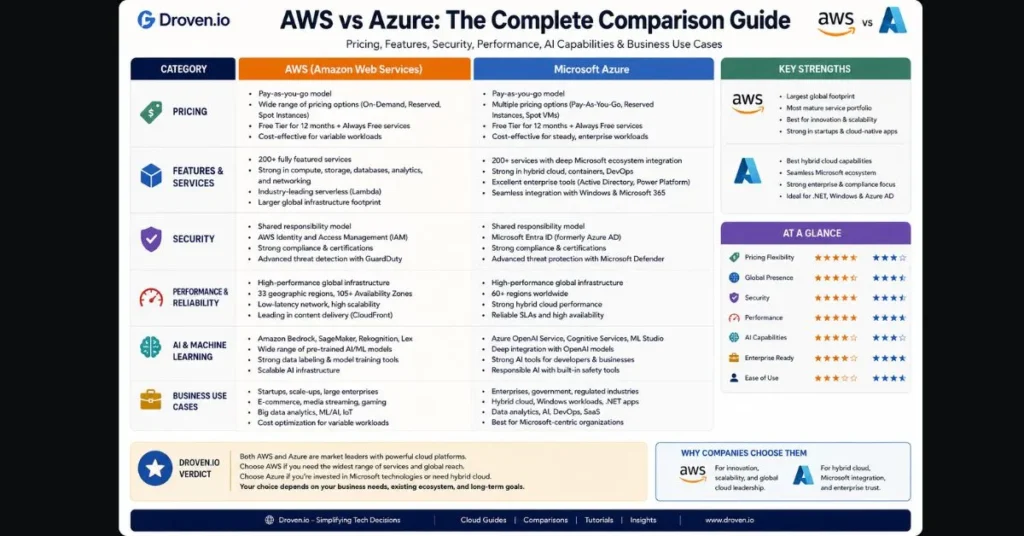
Quick Answer
When comparing Amazon Web Services (AWS) and Microsoft Azure, there is no universal winner. AWS offers the largest collection of cloud services and global infrastructure, while Azure excels in enterprise integration, Microsoft-based environments, and hybrid cloud solutions. The right choice depends on your company’s budget, existing technology stack, scalability requirements, and long-term business goals.
AWS vs Azure at a Glance
| Feature | AWS | Azure |
|---|---|---|
| Launch Year | 2006 | 2010 |
| Parent Company | Amazon | Microsoft |
| Global Availability Zones | 100+ | 140+ |
| Best For | Startups and developers | Enterprises and Microsoft users |
| Operating System Support | Linux and Windows | Strong Windows integration |
| Hybrid Cloud | Moderate | Excellent |
| Pricing Model | Pay-as-you-go | Pay-as-you-go |
| AI and Machine Learning | SageMaker, Bedrock | Azure AI, OpenAI services |
| Market Share | Largest cloud provider | Second-largest cloud provider |
| Popular Customers | Netflix, Airbnb, Samsung | Adobe, LinkedIn, Walmart |
Introduction
Cloud computing has become the backbone of modern businesses. Whether you’re running a startup, managing an e-commerce platform, or building enterprise software, choosing the right cloud provider can significantly impact your costs, performance, and scalability.
The two biggest names in the industry are Amazon Web Services (AWS) and Microsoft Azure.
Businesses visiting platforms like Droven.io often search for comparisons between AWS and Azure because both providers dominate the cloud market, yet they offer different strengths.
Questions such as these are increasingly common:
- Is AWS cheaper than Azure?
- Which platform is better for startups?
- Should enterprises choose Azure over AWS?
- Which cloud provider offers better AI tools?
- How do AWS and Azure compare in security?
This guide breaks down the key differences between AWS and Azure, helping businesses and developers make informed decisions.
What Is AWS?
Amazon Web Services (AWS) is Amazon’s cloud-computing platform that provides more than 200 services, including:
- Virtual servers
- Databases
- Storage
- Artificial intelligence
- Analytics
- Networking
- Security
- Internet of Things (IoT)
AWS is widely known for its scalability and extensive global infrastructure.
Popular AWS services include:
- EC2
- S3
- Lambda
- RDS
- DynamoDB
- SageMaker
- CloudFront
Because of its maturity and service variety, AWS is often the first choice for startups and technology companies.
What Is Microsoft Azure?
Microsoft Azure is Microsoft’s cloud platform, designed to integrate seamlessly with products such as:
- Windows Server
- Office 365
- Active Directory
- SQL Server
- Microsoft Teams
- Power BI
Azure offers:
- Virtual machines
- Storage solutions
- AI services
- Databases
- Analytics
- Security tools
- DevOps capabilities
Organizations already using Microsoft’s ecosystem often find Azure easier to adopt.
AWS vs Azure: Core Service Comparison
| Service Category | AWS Service | Azure Service |
|---|---|---|
| Virtual Machines | EC2 | Azure Virtual Machines |
| Object Storage | S3 | Blob Storage |
| Managed Database | RDS | Azure SQL Database |
| Serverless Computing | Lambda | Azure Functions |
| Kubernetes | EKS | AKS |
| Data Warehouse | Redshift | Synapse Analytics |
| AI and Machine Learning | SageMaker | Azure AI |
| Identity Management | IAM | Azure Active Directory |
Pricing Comparison
Pricing is one of the most important factors when choosing a cloud provider.
AWS Pricing
AWS uses a flexible pay-as-you-go model with options such as:
- On-demand pricing
- Reserved instances
- Spot instances
- Savings plans
AWS can be cost-effective for businesses with fluctuating workloads.
Azure Pricing
Azure also follows a pay-as-you-go model but offers additional discounts for organizations already using Microsoft products.
Benefits include:
- Azure Hybrid Benefit
- Enterprise agreements
- Reserved instances
- Long-term discounts
Pricing Summary
| Scenario | Better Choice |
|---|---|
| Startup with unpredictable traffic | AWS |
| Enterprise using Microsoft tools | Azure |
| Windows-heavy infrastructure | Azure |
| Linux-focused workloads | AWS |
Performance and Scalability
Both AWS and Azure are highly scalable, but there are differences.
AWS Strengths
- Larger service ecosystem
- Extensive developer community
- Proven scalability
- Strong support for containerized applications
Azure Strengths
- Enterprise-grade hybrid cloud
- Smooth Microsoft integration
- Excellent identity management
- Strong corporate support
For startups expecting rapid growth, AWS often has an edge.
For enterprises migrating legacy systems, Azure is frequently the preferred choice.
Security Comparison
Security is a top concern for every organization.
Both AWS and Azure provide:
- Encryption at rest
- Encryption in transit
- Multi-factor authentication
- Compliance certifications
- Identity management
- Threat detection
Security Features Comparison
| Security Feature | AWS | Azure |
|---|---|---|
| Multi-Factor Authentication | Yes | Yes |
| Identity Management | IAM | Azure AD |
| DDoS Protection | Yes | Yes |
| Encryption | Yes | Yes |
| Compliance Certifications | Extensive | Extensive |
Neither platform is inherently more secure; security largely depends on proper configuration.
AI and Machine Learning
Artificial intelligence is transforming the cloud industry.
AWS AI Services
AWS provides:
- SageMaker
- Bedrock
- Rekognition
- Lex
- Comprehend
Azure AI Services
Azure offers:
- Azure OpenAI Service
- Azure Machine Learning
- Cognitive Services
- Azure Bot Service
- AI Search
Businesses heavily invested in OpenAI technologies often prefer Azure because of Microsoft’s partnership with OpenAI.
AWS vs Azure for Different Business Types
| Business Type | Recommended Platform | Reason |
|---|---|---|
| Startup | AWS | More flexibility and developer tools |
| Small business | AWS | Easier scaling |
| Enterprise | Azure | Microsoft integration |
| Government agency | Azure | Strong compliance tools |
| AI startup | Azure | OpenAI ecosystem |
| E-commerce company | AWS | Global infrastructure |
Pros and Cons
AWS Pros
- Largest cloud market share
- Extensive documentation
- Broad service catalog
- Strong startup ecosystem
AWS Cons
- Can become expensive
- Steeper learning curve
- Complex pricing structure
Azure Pros
- Excellent Microsoft integration
- Strong hybrid cloud support
- Enterprise-friendly pricing
- Great identity management
Azure Cons
- Slightly smaller service ecosystem
- Some services have a steeper setup process
- Documentation can vary
Which Platform Should You Choose?
Choose AWS if:
- You’re building a startup.
- You rely heavily on Linux.
- You need maximum flexibility.
- You expect rapid growth.
Choose Azure if:
- Your company already uses Microsoft products.
- You need hybrid cloud capabilities.
- You rely on Active Directory.
- You want deep integration with Office 365 and Windows.
Ultimately, the best cloud provider depends on your business requirements rather than market popularity.
Conclusion
The Droven.io AWS vs Azure comparison isn’t about finding a single winner—it’s about identifying the platform that aligns with your goals.
AWS leads in terms of service variety, developer adoption, and startup support, while Azure dominates enterprise environments and Microsoft-based ecosystems.
Before making a decision, evaluate your infrastructure, team expertise, security requirements, and long-term growth strategy. The right cloud provider can reduce costs, improve performance, and accelerate innovation.
Frequently Asked Questions
Is AWS cheaper than Azure?
It depends on the workload. AWS may be cheaper for startups, while Azure often provides discounts for Microsoft customers.
Which cloud provider has more services?
AWS currently offers a larger number of cloud services.
Is Azure better for enterprises?
Yes, Azure is often preferred by enterprises already using Microsoft products.
Which platform is better for AI projects?
Azure has an advantage because of its OpenAI partnership, while AWS offers a broader range of AI tools.
Which cloud provider is easier to learn?
Azure may be easier for users familiar with Microsoft products, while AWS has a larger learning community.

Rob Kent is the editorial pen name used by the owner and editor of Kentfaith.de. He manages topic selection, research, fact-checking, editing and publication across the website. His practical experience includes search engine optimization, website management and online content publishing. Articles published under this name are reviewed for names, dates, relationships and current information, with important factual claims supported by reputable sources.