
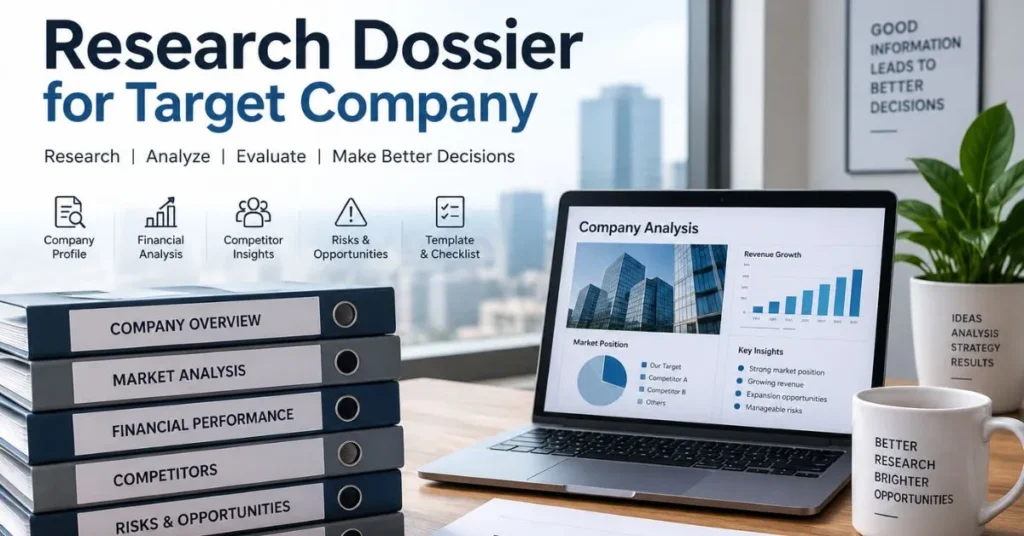
A research dossier for a target company is a structured report that brings together verified information about a business, its operations, financial performance, leadership, products, customers, competitors, market position, risks, and strategic direction.
Instead of keeping scattered notes across search results, company websites, financial reports, news articles, and databases, a research dossier organizes the information into one decision-ready document.
A good dossier does more than collect facts. It answers three important questions:
- What do we know about the company?
- How do we know it?
- What does the information mean?
That distinction is important. A company may report growing revenue, for example, but revenue growth alone does not explain whether the business is becoming more profitable, gaining market share, taking on additional risk, or becoming dependent on a particular product or customer group.
This guide explains how to research a target company, what information to include, how to verify evidence, how to analyze financial and competitive information, and how to create a reusable target company research dossier.
What Is a Research Dossier for a Target Company?
A research dossier for a target company is a detailed collection of company information, evidence, and analysis created for a specific research objective.
The phrase “target company” simply refers to the business being investigated. It does not necessarily mean Target Corporation. Your target company could be a public corporation, private business, startup, manufacturer, retailer, technology company, agency, supplier, or potential acquisition target.
A basic company profile might tell you:
- When the company was founded
- Where it is headquartered
- What it sells
- Who its executives are
- Where it operates
A research dossier goes considerably further.
It can also examine:
- How the company makes money
- Where revenue comes from
- Financial performance
- Employee and workforce trends
- Ownership
- Management
- Customers
- Competitors
- Market position
- Technology
- Intellectual property
- Legal and regulatory exposure
- Reputation
- Operational risks
- Growth opportunities
- Strategic developments
- Supporting evidence
The exact structure depends on the reason for the research.
An investor may focus on financial performance and risk. A sales team may care more about customers, products, decision-makers, and business priorities. A competitor may focus on pricing, market positioning, products, technology, and distribution.
The best dossier therefore starts with a research objective, rather than simply collecting everything available about a company.
Why Is a Target Company Research Dossier Important?
Online company research can become disorganized very quickly.
You might find leadership information on a corporate website, financial data in an annual report, employee information in a regulatory filing, competitor information in an industry publication, and recent developments in news coverage.
After collecting dozens of sources, several problems can appear:
- Which information is current?
- Which statistics are estimates?
- Which source is most reliable?
- Are two sources measuring the same thing?
- Does a number refer to the same reporting period?
- Is a statement an established fact or someone’s interpretation?
A research dossier solves this problem by giving each piece of information a defined place.
A dossier can help with:
Investment research
Investors can combine financial performance, business-model analysis, management information, competitive position, and risk assessment before making a decision.
Competitive intelligence
Businesses can examine competitors’ products, pricing, customers, positioning, distribution, technology, and strategic developments.
Sales research
B2B sales teams can understand a prospect’s business, products, leadership, recent developments, and potential business challenges before beginning outreach.
Marketing strategy
Marketing teams can use company research to identify customer segments, competitors, positioning opportunities, and market trends.
Vendor evaluation
A company dossier can help organizations evaluate suppliers, technology providers, agencies, manufacturers, and other potential partners.
M&A and due diligence preparation
A research dossier can provide an initial framework for understanding a potential acquisition target before more formal due diligence begins.
Academic and business research
Students, analysts, consultants, and researchers can use the same framework to produce structured company reports.
Research Dossier vs. Company Profile vs. Due Diligence
These terms are related, but they are not identical.
| Feature | Company Profile | Research Dossier | Due Diligence |
| Main purpose | Provide an overview | Build a detailed research record | Verify a business before a major decision |
| Company history | Usually included | Included | Relevant where necessary |
| Financial analysis | Basic | Detailed | Detailed and evidence-focused |
| Competitor research | Limited | Usually included | May be included |
| Risk analysis | Limited | Included | Core component |
| Evidence tracking | Sometimes | Important | Essential |
| Legal investigation | Usually limited | Relevant | Often extensive |
| Strategic analysis | Basic | Important | Important |
| Typical depth | Low to moderate | Moderate to high | High |
| Typical users | General readers | Analysts, marketers, investors, researchers | Investors, buyers, legal and financial teams |
A research dossier can therefore be viewed as a structured research foundation.
It may support due diligence, but it should not automatically be treated as a substitute for professional legal, financial, tax, or regulatory due diligence.
What Should a Target Company Research Dossier Include?
A complete dossier can contain the following sections:
- Research objective
- Executive summary
- Company identification
- Company history
- Ownership structure
- Products and services
- Business model
- Customers and target markets
- Leadership
- Organizational structure
- Financial performance
- Workforce
- Market position
- Competitor analysis
- Operations
- Technology and intellectual property
- Legal and regulatory information
- Reputation
- Risks
- Opportunities
- Strategic developments
- Evidence log
- Overall assessment
Not every project needs every section.
The research objective should determine the depth of each category.
Step 1: Define the Research Objective
Before searching Google, databases, filings, or news sites, define exactly what you want to discover.
For example:
Research objective: Evaluate the target company’s financial health, business model, competitive position, workforce scale, and major growth opportunities.
Or:
Research objective: Understand the target company’s products, customers, competitors, and digital market position before developing a competitive marketing strategy.
Or:
Research objective: Conduct preliminary research on a potential acquisition target and identify financial, operational, competitive, and regulatory issues that require further investigation.
A clear objective prevents the dossier from becoming a collection of unrelated facts.
Create Research Questions
Turn the objective into specific questions.
Useful questions include:
- What does the company sell?
- Who are its customers?
- How does it generate revenue?
- Where does it operate?
- Who owns the company?
- Who leads it?
- How large is its workforce?
- How has its financial performance changed?
- Who are its main competitors?
- What differentiates the company?
- What markets are growing?
- What risks could affect the business?
- What recent strategic changes have occurred?
- What information remains uncertain?
Every important source you collect should help answer at least one of these questions.
Step 2: Confirm the Correct Company
Company names can be surprisingly confusing.
A business may have:
- A legal name
- A consumer-facing brand
- A parent company
- Subsidiaries
- Regional entities
- Former names
- Multiple domains
Before collecting information, confirm:
- Legal company name
- Common or trading name
- Official website
- Headquarters
- Industry
- Parent organization
- Main geographic market
This is particularly important for searches involving the phrase target company because it can also produce information about the specific U.S. retailer Target Corporation.
Always use the exact company name and relevant context when conducting research.
Step 3: Start With Primary Sources
The company’s official website should normally be one of your first sources.
Useful pages include:
- About
- Leadership
- Products
- Services
- Investor Relations
- Careers
- Newsroom
- Press Releases
- Corporate Governance
- Sustainability
- Contact
These pages can establish basic facts about the company.
However, remember that a company website is a primary source, not necessarily an independent assessment.
A company will naturally describe its products, achievements, strategy, and competitive position positively.
Use official sources for facts, then use credible independent sources to add context and challenge assumptions.
Step 4: Research the Company’s History
A company’s history can explain how its current business model developed.
Research:
- Founding year
- Founders
- Original business
- Major acquisitions
- Major product launches
- Geographic expansion
- Rebranding
- Leadership changes
- Major restructuring
- Important partnerships
- Market exits
Don’t turn the dossier into a complete biography.
Focus on historical events that help explain the company’s current position.
For example, an acquisition may explain why a company suddenly entered a new market. A major product launch may explain a change in revenue composition. A restructuring may explain workforce changes.
The objective is context, not chronology for its own sake.
Step 5: Analyze Products and Services
Identify what the company actually sells.
Group products into meaningful categories rather than creating an enormous list.
For example, a software company might have:
- Enterprise software
- Consumer applications
- Cloud services
- Data products
- Professional services
A retailer might have:
- Grocery
- Electronics
- Clothing
- Beauty
- Household products
- Private-label products
For each major product or service, investigate:
- Target customer
- Price or pricing model
- Distribution channel
- Geographic availability
- Competitive alternatives
- Main differentiator
- Revenue importance, if disclosed
This provides the foundation for business-model and competitor analysis.
Step 6: Understand the Business Model
One of the most important questions in any research dossier is:
How does this company actually make money?
Revenue mechanisms may include:
- Product sales
- Subscription fees
- Licensing
- Advertising
- Memberships
- Marketplace commissions
- Transaction fees
- Professional services
- Consulting
- Franchising
- Usage-based pricing
Don’t stop at:
“The company sells products.”
Explain the economic structure.
For example:
The company generates revenue through direct product sales, recurring subscriptions, and enterprise service contracts.
Then investigate which revenue streams are most important.
Look for Revenue Concentration
Ask:
- Does one product generate most revenue?
- Does one customer group dominate?
- Is the company dependent on one geographic region?
- Is recurring revenue important?
- Does the business rely heavily on physical stores?
- Does it depend on third-party platforms?
Revenue concentration can reveal both strengths and risks.
Step 7: Analyze Financial Performance
Financial research should focus on trends, not isolated numbers.
Important metrics include:
Revenue
Revenue shows how much the business generated before expenses.
Compare multiple reporting periods whenever reliable data is available.
Gross Profit
Gross profit helps show how much remains after the direct cost of goods or services.
Operating Income
Operating income provides insight into profitability from core operations.
Net Income
Net income shows the company’s bottom-line result after expenses and other items.
Operating Cash Flow
Cash generated from operations can provide a different perspective from accounting profit.
Free Cash Flow
Free cash flow can help assess the cash available after capital expenditures.
Debt
Debt should be evaluated in context with cash, earnings, interest costs, and the company’s ability to service its obligations.
Step 8: Always Attach Dates to Financial Data
Never write:
The company has 50,000 employees.
Instead write:
The company reported approximately 50,000 employees as of the stated reporting date.
The same principle applies to:
- Revenue
- Market capitalization
- Store count
- Employee count
- Customer numbers
- Market share
- Debt
- Cash
- Geographic locations
Business information changes.
A statistic without a date can quickly become misleading.
Step 9: Research Leadership
Important leadership positions may include:
- Chief Executive Officer
- Chief Financial Officer
- Chief Operating Officer
- Chief Technology Officer
- Chief Marketing Officer
- Business-unit leaders
- Board leadership
Research:
- Current executives
- Recent leadership changes
- Relevant professional background
- Tenure
- Strategic responsibilities
Avoid including irrelevant personal information.
The objective is to understand how leadership may influence the company’s strategy and operations.
Step 10: Analyze the Workforce
Employee numbers can reveal useful information, but only when interpreted correctly.
Record:
- Employee count
- Reporting date
- Geographic scope
- Full-time/part-time status where available
- Major workforce changes
- Hiring trends
- Layoffs or restructuring
- Key hiring areas
A growing workforce may indicate expansion.
A shrinking workforce could indicate restructuring, automation, outsourcing, store closures, or declining demand.
But never assume that a reduction in employees automatically means financial trouble.
Always investigate the surrounding evidence.
Step 11: Analyze the Target Company’s Market
A company does not operate in isolation.
Research:
- Industry
- Market size
- Growth rate
- Customer trends
- Regulatory environment
- Technology changes
- Consumer behavior
- Economic conditions
- Major industry developments
Then ask:
How well is the company positioned within this market?
A rapidly growing company in a declining market may face different challenges from a slower-growing company in a rapidly expanding market.
Step 12: Conduct Competitor Analysis
Competitor analysis should go beyond listing company names.
Identify:
Direct competitors
Companies offering similar products to the same customers.
Indirect competitors
Companies solving the same customer problem through a different product or business model.
Emerging competitors
New businesses that could become significant threats.
For each important competitor, compare:
| Factor | Target Company | Competitor A | Competitor B |
| Main product | — | — | — |
| Target customers | — | — | — |
| Pricing | — | — | — |
| Geographic reach | — | — | — |
| Distribution | — | — | — |
| Brand position | — | — | — |
| Technology | — | — | — |
| Key strength | — | — | — |
| Major weakness | — | — | — |
Then explain what the comparison means.
A list of competitors is data.
A comparison is analysis.
Step 13: Examine Technology and Intellectual Property
Technology may be critical to the company’s competitive advantage.
Depending on the business, research:
- Software platforms
- Patents
- Proprietary technology
- Data infrastructure
- AI systems
- Manufacturing technology
- Ecommerce systems
- Mobile applications
- Cybersecurity
- Technology partnerships
For technology companies, this section may deserve significant depth.
For a traditional manufacturer, operational technology may matter more than software.
Again, tailor the dossier to the business.
Step 14: Review Legal and Regulatory Issues
A serious company dossier should identify relevant legal and regulatory information.
Look for:
- Major litigation
- Regulatory investigations
- Fines
- Product recalls
- Intellectual-property disputes
- Data privacy issues
- Employment disputes
- Environmental obligations
- Industry-specific regulations
Don’t turn allegations into established facts.
Clearly distinguish between:
- Filed cases
- Regulatory findings
- Settlements
- Allegations
- Company responses
- Final judgments
Legal information requires particularly careful sourcing.
Step 15: Research Reputation
Reputation can affect customer acquisition, employee recruitment, partnerships, and brand value.
Research:
- Customer reviews
- Industry commentary
- Media coverage
- Customer complaints
- Product reviews
- Employer sentiment
- Social media discussions
- Major reputation events
However, don’t treat a handful of online comments as representative of an entire customer base.
Look for recurring patterns.
For example:
Multiple independent sources consistently report complaints about delivery delays.
is more meaningful than:
One customer complained about delivery.
Step 16: Identify Business Risks
A useful dossier should not only describe what the company does well.
It should identify potential weaknesses.
Common categories include:
Financial risk
- High debt
- Weak cash generation
- Falling margins
- Revenue concentration
Market risk
- Declining demand
- New competitors
- Market saturation
- Changing consumer behavior
Operational risk
- Supply-chain dependence
- Manufacturing concentration
- Logistics problems
- Key supplier dependence
Technology risk
- Cybersecurity
- Outdated systems
- Technology disruption
- Dependence on third-party platforms
Regulatory risk
- New regulations
- Compliance requirements
- Litigation
- Licensing requirements
Management risk
- Leadership turnover
- Founder dependence
- Weak succession planning
A good risk section should explain both the risk and the evidence behind it.
Step 17: Identify Growth Opportunities
The same evidence used to identify risks can reveal opportunities.
Potential opportunities include:
- New geographic markets
- New customer segments
- New products
- Digital expansion
- Pricing opportunities
- Acquisitions
- Partnerships
- Automation
- New distribution channels
Avoid presenting every possibility as a prediction.
Use language such as:
The company’s existing distribution network may provide an opportunity to expand into adjacent product categories.
That is an evidence-based analytical observation rather than an unsupported forecast.
Step 18: Separate Facts, Estimates, and Analysis
This is one of the most important principles in professional company research.
Verified facts
Information directly supported by reliable evidence.
Example:
The company reported $X billion in annual revenue.
Estimates
Information produced by third-party research or analytical models.
Examples:
- Estimated website traffic
- Estimated private-company revenue
- Estimated market share
- Estimated valuation
Label estimates clearly.
Analysis
Your interpretation of the evidence.
Example:
The company’s increasing investment in ecommerce infrastructure may indicate that digital distribution is becoming a more important part of its growth strategy.
That is analysis, not a verified company statement.
Keeping these categories separate makes the dossier much more credible.
Step 19: Build an Evidence Log
An evidence log is one of the most useful features you can add to a target company research dossier.
Use a table such as:
| Claim or Data Point | Source | Date | Source Type | Status |
| Annual revenue | Annual report | Reporting date | Primary | Verified |
| Employee count | Company filing | Reporting date | Primary | Verified |
| Market share | Industry report | Publication date | Secondary | Estimate |
| CEO appointment | Company announcement | Announcement date | Primary | Verified |
| Competitive advantage | Multiple sources | Review date | Analysis | Interpretation |
The evidence log makes updates easier.
When new information becomes available, you can quickly locate the original source and determine whether the old information should be replaced.
Target Company Research Dossier Template
The following structure can be copied into a document, spreadsheet, or research platform.
1. Research Objective
Target company:
[Company name]
Official website:
[Domain]
Research date:
[Date]
Researcher:
[Name/team]
Primary objective:
[Why is this company being researched?]
Key research questions:
[Questions the dossier must answer]
2. Executive Summary
Company overview:
[Short summary]
Main findings:
[Most important discoveries]
Key strengths:
[Strengths]
Key risks:
[Risks]
Growth opportunities:
[Opportunities]
Overall assessment:
[Evidence-based conclusion]
3. Company Information
Legal name:
[Name]
Brand name:
[Name]
Founded:
[Year]
Founder(s):
[Names]
Headquarters:
[Location]
Industry:
[Industry]
Ownership:
[Public/private/subsidiary]
Parent company:
[If applicable]
Main markets:
[Regions]
4. Products and Services
Primary products:
[List]
Primary services:
[List]
Target customers:
[Customers]
Major revenue drivers:
[Revenue sources]
5. Business Model
How the company makes money:
[Explanation]
Revenue streams:
[List]
Sales channels:
[List]
Major costs:
[List]
Competitive advantage:
[Analysis]
6. Financial Analysis
Revenue:
[Figure + reporting period]
Revenue growth:
[Change]
Gross profit:
[Figure]
Operating income:
[Figure]
Net income:
[Figure]
Operating cash flow:
[Figure]
Free cash flow:
[Figure]
Debt:
[Figure]
Cash:
[Figure]
Financial assessment:
[Analysis]
7. Leadership
CEO:
[Name]
CFO:
[Name]
Other key executives:
[Names]
Board:
[Relevant information]
Recent leadership changes:
[Changes]
8. Workforce
Employee count:
[Number + date]
Geographic workforce:
[Information]
Recent workforce changes:
[Changes]
Workforce assessment:
[Analysis]
9. Market Analysis
Industry:
[Industry]
Market size:
[Figure + source/date]
Market growth:
[Growth]
Major trends:
[Trends]
Regulatory environment:
[Relevant factors]
Market position:
[Analysis]
10. Competitor Analysis
Direct competitors:
[List]
Indirect competitors:
[List]
Emerging competitors:
[List]
Competitive strengths:
[Analysis]
Competitive weaknesses:
[Analysis]
11. Technology and Intellectual Property
Core technology:
[Information]
Patents/IP:
[Information]
Technology partnerships:
[Information]
Technology risks:
[Analysis]
12. Legal and Regulatory Research
Major litigation:
[Information]
Regulatory issues:
[Information]
Intellectual-property disputes:
[Information]
Compliance considerations:
[Information]
13. Reputation
Customer sentiment:
[Findings]
Media coverage:
[Findings]
Employee sentiment:
[Findings]
Major reputation issues:
[Findings]
14. Risk Assessment
Financial risks:
[Analysis]
Market risks:
[Analysis]
Operational risks:
[Analysis]
Technology risks:
[Analysis]
Regulatory risks:
[Analysis]
Management risks:
[Analysis]
15. Opportunities
Growth opportunities:
[List]
New markets:
[List]
Product opportunities:
[List]
Strategic opportunities:
[List]
16. Evidence Log
| Claim | Source | Date | Type | Confidence |
| [Claim] | [Source] | [Date] | Primary | High |
| [Claim] | [Source] | [Date] | Secondary | Medium |
| [Claim] | [Source] | [Date] | Estimate | Medium |
| [Claim] | [Source] | [Date] | Analysis | — |
A Simple Target Company Research Scorecard
For projects that require a final evaluation, you can create a weighted score.
| Category | Suggested Weight |
| Financial health | 20% |
| Business model | 15% |
| Market position | 15% |
| Competitive strength | 15% |
| Leadership | 10% |
| Operational health | 10% |
| Technology/IP | 5% |
| Legal/regulatory risk | 5% |
| Reputation | 5% |
Score each category from 1 to 10.
Then calculate a weighted overall score.
For example:
Financial health: 8/10
Business model: 9/10
Market position: 7/10
Competitive strength: 8/10
Leadership: 7/10
The score should never replace detailed research.
Its purpose is to make your conclusion easier to compare across companies or across different research periods.
How to Research a Private Company
Private companies require a slightly different approach because they generally disclose less financial information than public companies.
Useful sources can include:
- Company website
- Government business registries
- Founder interviews
- Investor announcements
- Funding announcements
- Patent databases
- Job listings
- Customer reviews
- Industry publications
- Partner announcements
- Conference presentations
- Public contracts
- Regulatory records
Be especially careful with:
- Revenue estimates
- Employee counts
- Valuations
- Market share
- Customer numbers
Private-company statistics are often estimated.
Clearly identify estimates instead of presenting them as official figures.
How to Research a Public Company
Public companies generally provide more structured information.
Start with:
- Annual reports
- Quarterly reports
- Regulatory filings
- Investor presentations
- Earnings releases
- Earnings-call transcripts
- Corporate governance documents
- Official press releases
Then compare these primary sources with reputable independent reporting.
Look for changes rather than merely collecting numbers.
Ask:
Is revenue growing?
Then ask:
Why?
Then:
Is that growth profitable?
And finally:
Is the growth sustainable?
Those additional questions turn financial data into useful analysis.
How to Research a Startup
Startup research often requires more triangulation.
Research:
- Founders
- Investors
- Funding rounds
- Product
- Business model
- Target market
- Customers
- Partnerships
- Hiring
- Technology
- Competitors
- Intellectual property
- Market opportunity
A startup may not publish audited financial statements, so researchers need to distinguish clearly between verified information and estimates.
Job postings can sometimes provide useful clues about expansion plans, technology priorities, and hiring needs, but they should not be treated as proof of future strategy.
Common Target Company Research Mistakes
1. Collecting information without an objective
More information does not automatically create better research.
2. Using one source for everything
Important claims should be cross-checked.
3. Ignoring dates
A five-year-old employee count is not necessarily useful for understanding the current company.
4. Mixing estimates with facts
Always label estimated data.
5. Repeating corporate marketing claims
Company statements are useful evidence, but they are not automatically independent conclusions.
6. Listing competitors without analyzing them
A competitor list is only the beginning.
7. Ignoring negative information
A credible dossier should investigate weaknesses as seriously as strengths.
8. Treating online reviews as scientific samples
Customer reviews can reveal patterns, but they rarely represent the entire customer population.
9. Confusing a research dossier with formal due diligence
A research dossier can support due diligence but does not automatically replace professional legal, financial, tax, or regulatory review.
10. Failing to maintain the dossier
Company information changes continuously.
A dossier should be treated as a living research resource.
How Often Should a Research Dossier Be Updated?
There is no universal update schedule.
The appropriate frequency depends on the company and the purpose of the research.
For a fast-moving technology company, important information may change within weeks.
For a stable company, quarterly or semiannual reviews may be sufficient.
For an SEO-focused company research page, reviewing the article every two to three months is a practical starting point.
During each review, check:
- New financial results
- Leadership changes
- Employee numbers
- Acquisitions
- New products
- Geographic expansion
- Legal developments
- Competitor changes
- Market trends
- Broken links
- Outdated statistics
- New search questions
- Internal-link opportunities
Don’t rewrite content merely to make it longer.
Update it because the information or searcher’s needs have changed.
How AI Can Help With Company Research
AI can make the research process more efficient, but it should not be treated as the final authority for important company facts.
AI can help you:
- Build a research framework
- Generate research questions
- Organize notes
- Categorize evidence
- Compare companies
- Summarize long documents
- Identify missing sections
- Create tables
- Find inconsistencies
- Turn research into structured reports
However, important financial, legal, ownership, leadership, and corporate claims should be checked against reliable source material.
A good workflow is:
AI → organize and analyze → verify against primary sources → publish
rather than:
AI → assume everything is correct → publish
Research Dossier SEO Strategy
If you are publishing a research dossier guide online, the main topic should be supported by closely related search intent.
The primary topic is:
research dossier for target company
Related terms include:
- target company research
- target company research dossier
- company research report
- target company analysis
- target company profile
- company research framework
- target company research template
- company research dossier template
- how to create a research dossier
- target company due diligence
- company competitor analysis
- target company business model
- company research checklist
Do not force every phrase into the article.
Instead, create a logical content structure.
Main pillar
Research Dossier for Target Company
Supporting resources
- Target Company Research Dossier Template
- How to Create a Research Dossier
- Target Company Research Checklist
- Target Company Analysis Example
- Company Research Sources
- Target Company Competitor Analysis
- Company Financial Analysis
- Target Company Due Diligence Checklist
The supporting pages should link naturally to the main guide.
Research Dossier Checklist
Before completing your research, make sure you can answer:
- Have I confirmed the correct company?
- Have I identified the official website?
- Have I defined the research objective?
- Have I researched company history?
- Have I identified ownership?
- Have I reviewed products and services?
- Do I understand the business model?
- Have I identified major customers or customer groups?
- Have I researched leadership?
- Have I recorded employee information with a date?
- Have I analyzed financial performance?
- Have I researched the market?
- Have I identified direct competitors?
- Have I considered indirect competitors?
- Have I investigated technology and intellectual property?
- Have I checked relevant legal issues?
- Have I assessed reputation?
- Have I identified financial risks?
- Have I identified operational risks?
- Have I identified growth opportunities?
- Have I separated facts from estimates?
- Have I recorded sources?
- Have I attached dates to important statistics?
- Have I reviewed the evidence before writing the conclusion?
If several boxes remain unchecked, the dossier may not yet be ready for decision-making.
Final Takeaway
A research dossier for a target company should not be treated as a simple collection of facts.
The strongest dossier connects:
Company information → Evidence → Analysis → Risk → Opportunity → Decision
Start by defining the research objective. Confirm the correct company. Prioritize primary sources. Record reporting dates. Separate verified facts from estimates and analysis. Study the business model, financial performance, leadership, workforce, market, competitors, technology, legal exposure, reputation, and risks.
Most importantly, document the evidence behind important claims.
A well-built dossier becomes more than a one-time report. It becomes a reusable company intelligence resource that can support investment research, competitive analysis, sales preparation, marketing strategy, vendor evaluation, business planning, and preliminary due diligence.
When maintained properly, the dossier can be updated as the company changes rather than rebuilt from scratch every time new information is needed.
Frequently Asked Questions
What is a research dossier for a target company?
A research dossier is a structured document that collects and analyzes information about a selected company, including its business model, products, leadership, financial performance, competitors, market position, risks, and supporting evidence.
What should a target company research dossier include?
A typical dossier includes a research objective, company profile, history, ownership, products, business model, customers, leadership, financial information, workforce, competitors, market analysis, risks, opportunities, and an evidence log.
What is the difference between a company profile and a research dossier?
A company profile usually provides a concise overview. A research dossier goes deeper by combining company facts with financial research, competitive intelligence, risk analysis, evidence, and interpretation.
What sources are best for company research?
Primary sources such as regulatory filings, annual reports, government records, investor-relations documents, and official company announcements are generally the strongest starting points. Reputable independent sources can then provide context and verification.
How long should a research dossier be?
There is no fixed word count. A useful dossier should be as detailed as necessary to answer its research objective without adding irrelevant information.
How do I research a private company?
Start with the company’s website, government registries, founder information, funding announcements, patents, job listings, industry publications, customer feedback, partnerships, and other public records. Clearly label financial or market figures that are estimates.
Can AI create a research dossier?
AI can help structure, summarize, compare, and analyze research, but important company facts should be independently verified against reliable sources before they are treated as established information.
How often should a company research dossier be updated?
Update important sections whenever material company information changes. For web-based research content, a review every two to three months can help identify outdated facts and new developments.
Is a research dossier the same as due diligence?
No. A research dossier organizes company information and analysis. Formal due diligence is generally more comprehensive and may involve professional financial, legal, tax, regulatory, and operational investigation.





1 thought on “Research Dossier for Target Company: Complete Guide, Template & Example”