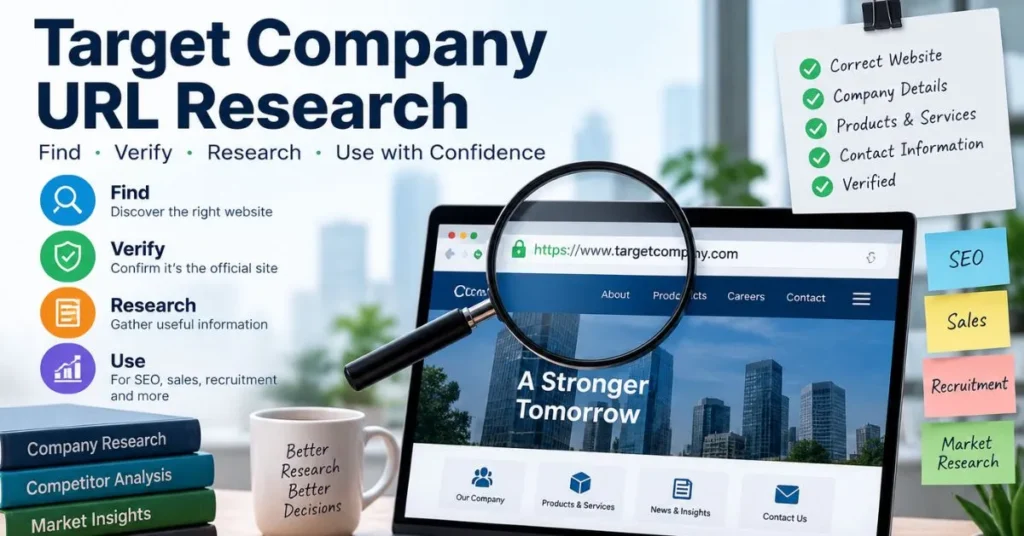
Target company URL research is the process of finding, identifying, verifying, and documenting the official website or domain associated with a specific company.
At first, finding a company website may seem as simple as searching its name on Google. In practice, it can be much more difficult. Companies may have similar names, operate under different legal names, use regional domains, change their websites after a rebrand, or have several domains associated with the same business.
A wrong URL can also create problems later. If you use an incorrect website for SEO research, sales prospecting, recruitment, competitor analysis, or company research, everything built on that information can become unreliable.
This guide explains target company URL research step by step, including how to find official company websites, verify URLs, handle difficult cases, record evidence, and use verified websites for deeper company research.
What Is Target Company URL Research?
Target company URL research is the structured process of connecting a target company with its correct and currently relevant website URL.
The objective is not simply to find a domain that looks related to the company. The objective is to establish a reasonable level of confidence that the website actually belongs to the company being researched.
For example, suppose your target company is
ABC Manufacturing Ltd.
A search might return:
- abcmanufacturing.com
- abcmanufacturing.co.uk
- abcmanufacturinggroup.com
- abcmanufacturing.net
- a similarly named company in another country
- a directory profile
- a social media page
Target company URL research determines which result represents the company you actually want to investigate.
A useful URL research record should normally include:
- Company name
- Legal company name, if available
- Country
- City or operating location
- Industry
- Candidate URLs
- Verified official URL
- Regional or international URL
- Parent company, if applicable
- Evidence supporting the match
- Verification status
- Date last checked
- Notes about uncertainty
Why Is Target Company URL Research Important?
A company URL is often the starting point for much deeper research.
If the URL is incorrect, the research that follows may also be incorrect.
Better company identification
A verified website helps distinguish companies with identical or similar names.
More accurate competitor research
SEO professionals and marketers can use verified company websites to investigate competitors, products, content, and website structures.
Cleaner sales databases
Sales teams can associate prospects with the correct company domains instead of unrelated websites.
Better recruitment research
Recruiters can distinguish an employer’s official website from job boards, recruitment agencies, and similarly named businesses.
More reliable market research
Researchers can use the official website as a first-party source for information about products, services, locations, leadership, and company activities.
Stronger company dossiers
A verified URL is an important starting point for creating a broader target company research dossier.
Target Company URL Research: The Complete Process
A reliable process should move from company identification to URL discovery, verification, evidence collection, and deeper research.
1. Define the Target Company
Before searching for a URL, establish exactly which company you are researching.
Record as much identifying information as possible:
- Company name
- Legal name
- Country
- City
- Industry
- Product or service
- Known brand name
- Parent company
- Subsidiaries
- Company registration information
- Known social profiles
The more identifying information you have, the easier it becomes to distinguish the correct business from similarly named companies.
2. Clean and Standardize the Company Name
Company names can appear in different formats.
For example:
- Example Technologies Ltd.
- Example Technologies Limited
- Example Technologies
- Example Tech
- Example Technologies Inc.
Standardize the name before performing URL research.
Remove unnecessary punctuation and normalize common legal suffixes where appropriate.
However, do not permanently remove the legal name from your research record. The legal identity may be important when verifying the company later.
3. Find Candidate Company URLs
Search for several possible URLs rather than automatically accepting the first result.
Useful search combinations include:
- Exact company name
- Company name + official website
- Company name + country
- Company name + city
- Company name + industry
- Company name + products
- Company name + contact
- Company name + careers
The purpose of this stage is candidate discovery, not final verification.
4. Check Whether the URL Is Actually Official
Once you find a potential website, inspect the website itself.
Look for:
- Company name
- About page
- Contact information
- Physical address
- Products or services
- Leadership information
- Company history
- Legal information
- Careers page
- Corporate email addresses
A domain name alone is not sufficient evidence.
5. Verify the Company URL
Compare information on the website with information from independent or first-party sources.
For example, verify whether the:
- Company name matches
- Location matches
- Products match
- Contact details match
- Leadership information matches
- Social profiles point to the same domain
- Legal information supports the identity
The goal is to build several independent signals supporting the URL-company relationship.
6. Calculate a Target Company URL Confidence Score
A practical way to standardize decisions is to assign a confidence score.
The following is a custom research framework, not an official industry standard.
| Verification Signal | Points |
| Company name clearly matches | 20 |
| Products or services match | 15 |
| Company location matches | 15 |
| Official contact information matches | 15 |
| Company email uses the domain | 10 |
| Official social profile links to the domain | 10 |
| Independent source confirms the company | 5 |
| Legal/company information supports the match | 5 |
| Current website is active and consistent | 5 |
| Total | 100 |
A useful interpretation is:
- 90–100: High confidence
- 75–89: Good confidence
- 50–74: Needs review
- Below 50: Low confidence
This score should support human judgment rather than replace it.
7. Record Your Evidence
Do not record only the final URL.
Record why you believe the URL is correct.
For example:
| Field | Example |
| Target company | Example Technologies |
| Candidate URL | example.com |
| Company name verified | Yes |
| Location verified | Yes |
| Products verified | Yes |
| Contact verified | Yes |
| Social profile confirms | Yes |
| External source confirms | Yes |
| Confidence score | 95/100 |
| Status | Verified |
| Last checked | September 2026 |
An evidence record makes the research easier to audit and update.
8. Use the Verified URL for Company Research
Once the URL has been verified, it becomes the foundation for deeper research.
You can investigate:
- Company history
- Products
- Services
- Leadership
- Locations
- Careers
- News
- Technology
- Market positioning
- Competitors
- Partnerships
- Corporate developments
This is where URL research becomes part of broader target company research.
Once the company URL has been verified, you can use it as the foundation for a target company research dossier, where you can analyze the company’s history, business model, products, competitors, financial information, risks, and opportunities.
How to Find a Target Company’s Official Website
Finding a target company’s official website requires more than entering its name into a search engine.
Search the Exact Company Name
Start with the company’s full name.
Quotation marks can be useful when you want results closely associated with the exact name.
Add the Country or Location
If the company operates in a specific country, include that information.
For example:
Company Name + Germany
or:
Company Name + Berlin
This can eliminate many similarly named businesses.
Add the Industry or Product
Adding an industry or product can help separate companies with similar names.
For example:
Company Name + photography equipment
may be more useful than searching for the company name alone.
Search for the Company’s Official Website
Queries containing terms such as:
- official website
- company website
- contact
- headquarters
- careers
can help identify relevant results.
Remember that search results are discovery tools. The result still needs verification.
Use Known Company Identifiers
If available, use:
- Legal company name
- Registration number
- Headquarters
- Founder
- CEO
- Product name
- Brand name
- Country
- Industry
These identifiers can dramatically reduce false matches.
How to Verify a Target Company URL
Finding a URL is only half of the job. Verification determines whether it should actually be used.
Check the Company Name
The website should clearly identify the company.
Check the:
- Homepage
- About page
- Footer
- Contact page
- Legal pages
The company name should be consistent or explain any difference between the legal entity and brand.
Compare Products and Services
Does the website describe the same products or services associated with your target company?
A matching company name with completely different products is a warning sign.
Verify the Company Location
Compare the company’s stated:
- Headquarters
- Offices
- Country
- City
- Service area
with your research records.
Location is especially useful when several companies share the same name.
Check Contact Information
Look for:
- Business address
- Telephone number
- Contact email
- Support information
- Sales contact
- Corporate contact details
A domain-specific email address can provide an additional verification signal.
Verify Leadership and Ownership
Compare leadership information where available.
For example:
- CEO
- Founder
- Directors
- Management team
- Parent company
Leadership information can help distinguish two businesses with similar names.
Check Official Social Profiles
Look at official social profiles and determine whether they link to the same website.
Useful sources may include:
- YouTube
- X
- Industry-specific profiles
Social profiles should be treated as supporting evidence rather than the sole proof of ownership.
Check Legal and Corporate Information
Where appropriate, compare the website against reliable corporate records, regulatory information, filings, or other authoritative sources.
This is particularly important for companies operating under a brand name that differs from their legal entity.
Confirm the Domain Is Active
Check whether the website:
- Loads correctly
- Uses the expected domain
- Redirects somewhere else
- Displays current company information
- Contains broken or outdated pages
- Has moved to another domain
An old domain may still exist without being the company’s current website.
Target Company URL Verification Score
A scoring system makes URL research more consistent when dealing with large company lists.
URL Verification Scoring Framework
Use the custom 100-point framework above to evaluate the strength of your match.
The important principle is to combine multiple signals.
A domain should not receive a high score simply because its name resembles the company name.
How to Interpret the Confidence Score
90–100: High confidence
The available evidence strongly supports the URL-company match.
75–89: Good confidence
The URL is probably correct, but additional confirmation may be useful.
50–74: Needs review
There is meaningful evidence, but important details remain uncertain.
Below 50: Low confidence
Do not treat the URL as verified without further research.
When a URL Should Be Marked “Needs Review”
Use a review status when:
- Two companies have the same name
- The website has little identifying information
- The company has recently rebranded
- The domain redirects unexpectedly
- The website is inactive
- A parent company relationship is unclear
- Location information conflicts
- Products do not clearly match
- Only third-party directories confirm the URL
How to Handle Companies With Similar Names
Similar company names are one of the biggest challenges in target company URL research.
Same Company Name in Different Countries
Always compare the country and location.
A company called “ABC Solutions” in the United States may have no relationship with another “ABC Solutions” in the United Kingdom.
Similar Company Names in the Same Industry
Compare:
- Products
- Customers
- Locations
- Leadership
- Company history
- Social profiles
A small spelling difference can represent an entirely different business.
Brand Name vs. Legal Company Name
A company may market itself using a brand while operating legally under another name.
For example:
Brand: Example
Legal entity: Example Holdings Limited
Do not automatically assume that a different legal name means the website is unrelated.
Parent Company vs. Subsidiary
A target company may have a website under:
- Its own domain
- Its parent’s domain
- A regional domain
- A dedicated brand domain
Record the relationship rather than forcing every company into a single-domain model.
How to Research Regional and International Company Websites
International businesses frequently use multiple domains.
Global vs. Regional Domains
A company may use:
- .com
- .co.uk
- .de
- .fr
- .jp
- .au
The correct URL depends on the research objective.
If you are researching the global company, the global domain may be preferable.
If you are researching a specific national operation, a regional domain may provide more relevant information.
Country-Specific Company Websites
Regional websites may contain different:
- Products
- Prices
- Contact details
- Regulations
- Careers
- Offices
- Customer support information
Always document which version you used.
Multiple Domains for the Same Company
Do not automatically treat multiple domains as separate companies.
A business may own several domains for:
- Brand protection
- Country operations
- Product lines
- Marketing campaigns
- Previous websites
- Acquisitions
Determine which domain is currently official and record other domains as related URLs where useful.
What to Do When a Company Changes Its Domain
Companies do not always keep the same website forever.
Rebranded Companies
A company may change its name and domain after a rebrand.
Record both the old and new identity when historical research matters.
Redirected Domains
An old domain may redirect to the company’s new website.
A redirect can be useful evidence of continuity, but it should not automatically be treated as the current official URL.
Acquired Companies
An acquired business may become part of a parent company’s website.
Check whether the original website remains active or whether the business has been integrated into the parent’s domain.
Expired or Inactive Company Websites
If the old website no longer works, search for newer evidence.
Potential sources include:
- Current corporate websites
- Official social profiles
- Regulatory records
- Business directories
- Company announcements
- Parent company websites
Document the old domain and explain why it is no longer being treated as current.
What If a Target Company Has No Website?
Not every company has a clearly identifiable standalone website.
Using Official Social Profiles
An official social profile can provide useful evidence about:
- Company name
- Location
- Products
- Contact information
- Website links
However, it should not automatically be labeled the company’s website.
Using Business Directories
Directories can help discover company information, but they should generally be treated as secondary evidence.
A directory listing is not necessarily an official company website.
Using Parent Company Websites
If the target is a subsidiary or acquired company, its information may be hosted on the parent company’s website.
Documenting “No Verified Website Found”
If extensive research produces no reliable website, record:
No verified website found
rather than guessing.
This is much better for research quality than assigning an unrelated domain.
How to Research a Company After Finding Its URL
Finding the website should be the beginning of company research, not the end.
Research the About Page
The About section may reveal:
- Company history
- Mission
- Leadership
- Locations
- Ownership
- Milestones
Research Products and Services
Review the company’s main offerings.
Record:
- Product categories
- Services
- Target customers
- Pricing information
- Market positioning
- Geographic availability
Check the Contact Page
The Contact section can help verify:
- Headquarters
- Regional offices
- Phone numbers
- Email addresses
- Business locations
Research the Careers Section
Careers pages can reveal:
- Hiring locations
- Departments
- Company culture
- Expansion plans
- Open roles
- Employer branding
Check News and Press Releases
Company announcements can reveal:
- New products
- Partnerships
- Acquisitions
- Leadership changes
- Expansion
- Strategic initiatives
Review Investor Relations
For public companies, investor materials can provide deeper information about:
- Revenue
- Business segments
- Strategy
- Risk factors
- Management
- Corporate structure
Analyze the Company’s Website Structure
The website itself can provide useful research signals.
Look at:
- Main navigation
- Product architecture
- Content categories
- Country directories
- Resource sections
- Customer segments
- Technology pages
- Partner pages
Target Company URL Research for SEO
Verified company URLs can be valuable for competitor and market analysis.
Finding Competitor Websites
Create a verified list of competitor domains before beginning competitive SEO analysis.
This reduces the risk of analyzing the wrong company.
Competitor Keyword Research
Once competitor URLs are confirmed, they can be used to study:
- Content themes
- Search intent
- Product pages
- Informational content
- Commercial pages
- Topic coverage
Finding Content Gaps
Compare your website with verified competitors to identify topics or search intents that may be underdeveloped.
Competitor Backlink Research
Verified domains can also serve as inputs for backlink analysis and competitive research.
The quality of the competitor list matters because analyzing the wrong domain can produce misleading SEO conclusions.
Target Company URL Research for Sales and Lead Generation
Sales teams often work with large company lists, making URL verification especially useful.
Building a Clean Prospect Database
A prospect record can include:
- Company name
- Official URL
- Country
- Industry
- Company size
- Contact information
- Research status
Verifying B2B Company Domains
A verified company domain can help connect a prospect record with the correct organization.
Enriching Sales Records
After verification, additional information can be associated with the correct company:
- Employees
- Locations
- Products
- Industry
- Leadership
- Careers
- News
Target Company URL Research for Recruitment
Recruiters can also benefit from verified company websites.
Finding Official Careers Pages
After identifying the correct company URL, look for its careers or jobs section.
Verifying Employer Websites
Compare employer information across the website and other sources before treating a company as a confirmed employer.
Separating Company Websites From Job Boards
Job boards and recruitment websites can appear prominently in search results.
They may provide useful job information, but they should not be confused with the employer’s official website.
Target Company URL Research for Market Research
A verified URL provides a strong starting point for understanding a company.
Company Information
Research:
- History
- Locations
- Ownership
- Leadership
- Company size
Products and Services
Identify the company’s main offerings and customer groups.
Market Position
Analyze how the company describes itself and the market it serves.
Competitors
Look for direct and indirect competitors mentioned through company materials, industry research, and market analysis.
Business Developments
Monitor:
- Partnerships
- Product launches
- Expansion
- Acquisitions
- Leadership changes
Target Company URL Research for CRM Data Quality
Poor URL data can create duplicate or inaccurate CRM records.
Common CRM URL Problems
Examples include:
- Missing URLs
- Wrong domains
- Old domains
- Duplicate companies
- Parent company URLs
- Regional URLs
- Brand URLs instead of corporate URLs
Creating a Standardized URL Record
Use a consistent structure such as:
Company → Legal Name → Country → Official URL → URL Status → Confidence Score → Last Verified
Updating and Rechecking Company URLs
Company websites change.
For important databases, establish a review schedule based on how frequently the information is used and how quickly the underlying companies change.
Manual vs. Automated Target Company URL Research
Different research projects require different levels of automation.
Manual URL Research
Manual research works well when:
- The company list is small
- Accuracy is more important than speed
- Companies are complex
- Many similar names exist
- Corporate relationships require judgment
Automated URL Research
Automation is useful when:
- Company lists are large
- Initial candidate discovery is repetitive
- You need standardized outputs
- Bulk processing is required
Automation can quickly generate candidate matches, but it should not eliminate verification.
Hybrid URL Research
For many projects, a hybrid workflow is the most practical:
- Automatically discover candidates.
- Assign preliminary confidence.
- Review uncertain matches manually.
- Verify high-value companies.
- Record evidence.
- Store the final URL.
Can AI Help With Target Company URL Research?
AI can assist with company URL research, especially when processing large datasets.
What AI Can Do
AI can help:
- Normalize company names
- Identify potential matches
- Compare company descriptions
- Extract website information
- Organize evidence
- Classify confidence levels
- Flag ambiguous companies
Where AI Can Make Mistakes
AI may confuse:
- Similar company names
- Parent companies
- Subsidiaries
- Brands
- Regional operations
- Former domains
- Unrelated businesses
It may also produce a plausible-looking URL without sufficient evidence.
How to Verify AI-Generated URL Matches
Treat AI output as a research lead rather than final evidence.
For important matches:
- Open the website.
- Confirm company identity.
- Compare location.
- Compare products or services.
- Check contact information.
- Look for external confirmation.
- Record the evidence.
How to Build a Scalable Target Company URL Research Workflow
A scalable workflow should separate reliable matches from uncertain ones.
High-Confidence Matches
Mark companies as Verified when sufficient evidence supports the URL.
Uncertain Matches
Mark companies as Needs Review when important evidence is missing or conflicting.
No-Match Companies
Use No Verified Website Found when no reliable website can be established.
URL Verification Statuses
A simple status system can include:
- Verified
- Likely
- Needs Review
- Redirected
- Inactive
- No Verified Website Found
This makes large research projects easier to manage and update.
How Often Should Company URLs Be Checked?
The appropriate frequency depends on the purpose of the database.
For a short-term research project, checking the URL when the research begins may be sufficient.
For a sales, SEO, recruitment, or market intelligence database, URLs should be reviewed periodically.
A recheck may be especially useful when:
- A company is acquired
- A company rebrands
- A domain redirects
- A company changes ownership
- A website becomes inactive
- A company expands internationally
For important records, store a last verified date so users know how current the information is.
Privacy and Ethical Considerations in Company URL Research
Company URL research should focus on legitimate business information.
Good practices include:
- Use publicly available company information.
- Respect website terms and applicable laws.
- Avoid collecting unnecessary personal information.
- Do not misrepresent yourself when contacting companies.
- Keep research records focused on legitimate business purposes.
- Treat automated results as candidates until verified.
URL research should improve data quality rather than become a method for collecting unnecessary personal information.
Who Can Benefit From Target Company URL Research?
Target company URL research can be useful for:
- SEO professionals
- Digital marketers
- Sales teams
- Lead-generation teams
- Recruiters
- Market researchers
- Business analysts
- Investors
- M&A researchers
- Journalists
- Competitive intelligence teams
- CRM administrators
- Data-enrichment teams
- Researchers building company databases
Target Company URL Research Worksheet
A simple worksheet makes the process repeatable.
Company Identification Fields
Record:
- Target company name
- Legal company name
- Country
- City
- Industry
- Brand
- Parent company
- Subsidiary
- Known identifiers
URL Verification Fields
Record:
- Candidate URL 1
- Candidate URL 2
- Current official URL
- Global URL
- Regional URL
- Old URL
- Redirect status
- URL status
Evidence and Confidence Fields
Record:
- Company name verified
- Location verified
- Products/services verified
- Contact information verified
- Official email verified
- Social profile confirms
- External source confirms
- Legal information confirms
- Confidence score
- Last verified date
- Source links
- Research notes
Target Company URL Research Checklist
Use this checklist before marking a company URL as verified.
Company Identity Checklist
- Company name identified
- Legal name checked
- Country confirmed
- Location confirmed
- Industry confirmed
- Brand relationship checked
- Parent/subsidiary relationship checked
Website Verification Checklist
- Company name appears on the website
- Products/services match
- Location matches
- Contact details are consistent
- Corporate email uses the domain where appropriate
- Website appears current
- Domain redirects have been checked
External Evidence Checklist
- Official social profile checked
- Independent source checked
- Corporate/legal information checked where relevant
- Parent company relationship checked
- Old domain checked where relevant
Final Verification Checklist
- Confidence score assigned
- URL status recorded
- Evidence recorded
- Last verified date recorded
- Uncertainty documented
Common Target Company URL Research Mistakes
Choosing the First Search Result
The first result is not automatically the official website.
Trusting the Domain Name Alone
A domain that contains the company name can still belong to another business.
Ignoring Company Location
Location is one of the easiest ways to separate similarly named companies.
Confusing a Brand With Its Parent Company
A brand website may not represent the legal entity you are researching.
Using an Unverified Directory Listing
Directories are useful discovery sources, but a listing does not automatically prove domain ownership.
Ignoring Old or Redirected Domains
A company may have changed its website after a rebrand, merger, acquisition, or restructuring.
Accepting Automated Matches Without Review
Automated matching is useful for scale, but ambiguous companies still require human verification.
How URL Research Fits Into a Target Company Research Dossier
Target company URL research is often the first stage of a larger research process.
Once the official URL is established, it can become a primary source for the company dossier.
A broader target company research dossier can then cover:
- Company history
- Business model
- Products and services
- Leadership
- Financial information
- Market position
- Competitors
- Technology
- Legal considerations
- Reputation
- Risks
- Opportunities
- Investment considerations
The relationship is simple:
Find the company → verify the URL → research the company → organize the evidence → build the dossier.
If you are building a complete target company research process, keeping URL verification separate from broader company analysis can make the final research much more reliable.
Target Company URL Research Template
Use the following structure for individual company research.
Company Information
Company Name:
Legal Name:
Country:
City:
Industry:
Brand:
Parent Company:
Subsidiary:
URL Verification Information
Candidate URL 1:
Candidate URL 2:
Current Official URL:
Global URL:
Regional URL:
Previous URL:
URL Status:
Confidence Score:
Last Verified:
Evidence and Research Notes
Company Name Evidence:
Location Evidence:
Product/Service Evidence:
Contact Evidence:
Social Profile Evidence:
External Evidence:
Legal/Corporate Evidence:
Notes:
For larger projects, use the same fields across every company so the records can be compared consistently.
Final Takeaway
Target company URL research is more than finding a website address.
The real objective is to establish a reliable connection between a specific company and the correct current website.
A strong workflow should:
- Identify the exact company.
- Standardize the company name.
- Find multiple candidate URLs.
- Verify the website’s company identity.
- Compare location, products, contact details, and other signals.
- Assign a confidence score.
- Record supporting evidence.
- Use the verified URL for deeper company research.
This approach is useful for SEO, sales, recruitment, market research, CRM management, competitive intelligence, and business analysis.
Most importantly, do not guess when the evidence is unclear. A clearly marked “Needs Review” or “No Verified Website Found” is more valuable than an incorrect URL presented as fact.
Once the URL is verified, you can move from simple website identification to a complete target company research dossier, using the website as one of the foundations for deeper business analysis.
Free Research Resource: Use a structured dossier worksheet to document company information, URLs, verification evidence, financial research, competitors, risks, opportunities, and final conclusions.
Frequently Asked Questions
What is target company URL research?
Target company URL research is the process of finding and verifying the correct official website or domain associated with a specific company.
How do I find a target company’s official website?
Start with the exact company name and add identifying information such as country, city, industry, products, or legal name. Then verify the website using company information and supporting sources.
How do I know if a company URL is legitimate?
Check whether the website’s company name, products, location, contact details, leadership, and other identifying information match the target company. Use multiple verification signals rather than relying only on the domain name.
Can I research company URLs in bulk?
Yes. Bulk URL research can be useful for large company lists. Automated tools can help discover candidate domains, but uncertain matches should still be reviewed.
What should I do if two companies have the same name?
Compare their country, location, industry, products, leadership, and other identifying information. Never select a URL solely because the domain name matches.
What if a company has changed its domain?
Check for redirects, rebranding announcements, current corporate information, parent-company websites, and official social profiles. Record both the old and current domains when historical context matters.
Should I use a global or regional company URL?
Use the URL most relevant to your research objective. A global domain may be appropriate for corporate research, while a regional domain may provide better information for a specific country or market.
Can AI find company URLs?
AI can help identify potential company URLs and organize research, but AI-generated matches should be independently verified before being treated as reliable.
Is a company directory the same as the official company website?
No. A directory may provide useful information about a company, but it is generally not the company’s official website.
Why is URL verification important for SEO?
SEO research depends on analyzing the correct domains. Using an unrelated or incorrectly matched website can distort competitor, keyword, content, and backlink analysis.
Can URL research help with recruitment?
Yes. A verified company URL can help recruiters locate official careers pages and distinguish employers from job boards and third-party recruitment websites.
What information should I record after finding a company URL?
At minimum, record the company name, official URL, country, verification evidence, URL status, confidence score, source information, and date last verified.