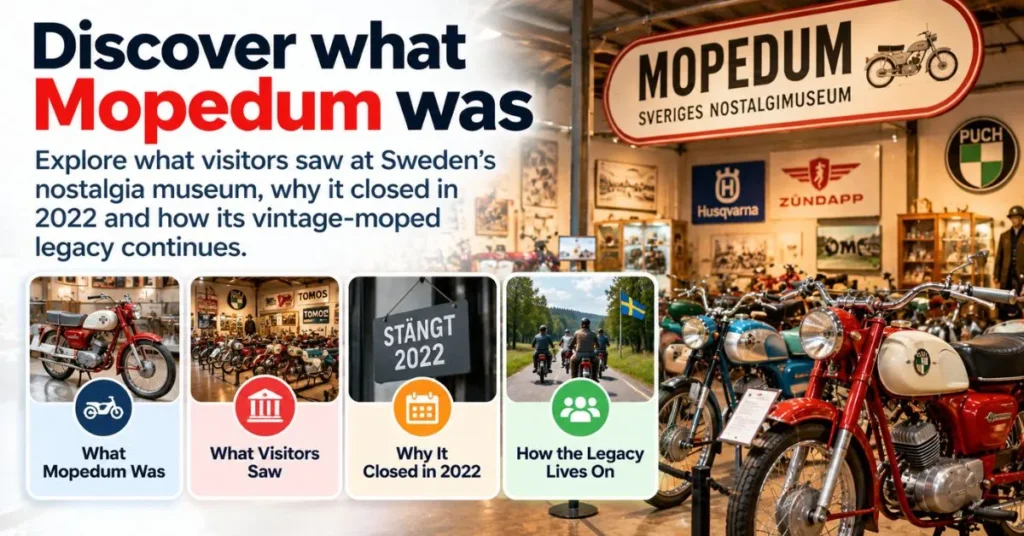
Mopedum was a distinctive Swedish nostalgia museum that used vintage mopeds to tell a much broader story about everyday life. Located in Nynäshamn, south of Stockholm, the museum combined classic two-wheelers with clothing, toys, furnishings, shop displays and other objects associated with the 1950s, 1960s and 1970s.
The original attraction is no longer open. Contemporary tourism information announced that it would close permanently in December 2022, and no reliable evidence indicates that the Nynäshamn museum has reopened. This distinction matters because old reviews, photographs and directory listings can still make Mopedum appear to be a current visitor attraction.
Today, the name remains connected with Swedish moped culture. A website using it publishes material about veteran mopeds and nostalgia, while memories and surviving displays preserve aspects of the former museum’s work. This guide explains what Mopedum was, what made it unusual, why its closure can be confusing online and what researchers or travelers should understand now.
Quick Answer
Mopedum was a private nostalgia museum in Nynäshamn, Sweden, focused on vintage mopeds and Swedish everyday culture. Its displays recreated parts of life from the postwar decades rather than presenting vehicles as isolated machines.
The museum stood at Vikingavägen 39 in Nynäshamn. A regional tourism listing stated that it would close for good in December 2022. Therefore, old opening hours, admission details and visitor recommendations should be treated as historical information.
The active dot-se website using the Mopedum name is an online publication about veteran mopeds and nostalgia. Its activity does not mean that the original physical museum is open again.
What Was Mopedum?
Mopedum was also known as Mopedum – Svenska Nostalgimuseet, meaning a Swedish nostalgia museum. The name appears to blend “moped” with a museum-like ending, neatly describing the attraction’s theme.
Although mopeds were central, the institution was not simply a technical vehicle collection. It presented them within reconstructed environments filled with period objects. Visitors could encounter domestic furnishings, clothing, toys, commercial displays and entertainment associated with earlier Swedish life.
This method gave the vehicles social context. A moped could represent affordable mobility, youth independence, daily commuting, mechanical simplicity and changing consumer culture. The household objects around it helped visitors imagine how people lived when those machines were new.
Mopedum’s historical emphasis is commonly described as covering the decades from the 1950s through the 1970s. The numbers 1952–1979 appeared prominently in the museum’s identity and were presented as the moped’s Swedish golden age.
Where Was Mopedum Located?
The museum was located in Nynäshamn, a coastal locality in Stockholm County. Its recorded address was Vikingavägen 39, 149 40 Nynäshamn, Sweden.
Nynäshamn lies south of central Stockholm and is associated with its harbor, archipelago connections and coastal setting. That made Mopedum a possible addition to a day trip rather than a central Stockholm attraction.
The address remains historically useful, but it should not be entered into a current itinerary as though admission were still available. A surviving listing or map marker can preserve the location of a former attraction long after operations have ended.
Is Mopedum Still Open?
No. The original Mopedum museum in Nynäshamn is permanently closed.
The clearest public evidence comes from an established regional tourism listing. Its Mopedum page invited visitors to experience nostalgia from the 1950s, 1960s and 1970s, but it also stated that the museum would close for good in December 2022.
Historical social-media material, local reporting and later retrospectives are consistent with that closure. The continued existence of photographs, reviews and an active domain does not establish a reopening.
Anyone planning a Swedish museum trip should exclude the former Nynäshamn attraction unless a future reopening is announced by a clearly identified operator and confirmed through current local sources.
Mopedum Status at a Glance
| Question | Current answer |
|---|---|
| Was Mopedum a real museum? | Yes, it was a physical nostalgia museum in Nynäshamn |
| What was its main subject? | Vintage mopeds and Swedish everyday life from earlier decades |
| Is the original museum open? | No, it closed permanently in December 2022 |
| Can old visitor hours be trusted? | No, they describe a former attraction |
| Does an active website mean the museum reopened? | No, online publishing and physical museum operations are separate |
| Is the name still relevant? | Yes, it remains associated with veteran-moped history and nostalgia |
Why Online Information Can Be Confusing
Mopedum accumulated years of reviews, travel recommendations, photographs and directory records while it operated. Search engines may continue to display those pages without making their age or status obvious.
Several factors create confusion:
- old visitor reviews remain useful accounts of the experience but not of current access;
- travel directories may preserve outdated hours or attraction descriptions;
- map services can retain a place entry after closure;
- social-media pages and photographs can remain visible indefinitely;
- the Mopedum name is still active online in vintage-moped publishing;
- recent articles may discuss the museum historically without making the closure prominent.
The publication date of a page is not enough. A new article can repeat old visitor information, while an older regional listing may contain the decisive closure notice. Travelers should check whether a source provides current ticketing, opening hours and operator details rather than merely describing what the museum once offered.
What Visitors Saw at Mopedum
The attraction’s appeal came from the combination of vehicles and carefully chosen period objects. Instead of arranging mopeds in plain rows, the museum placed them within a story of Swedish social change.
Documented descriptions refer to classic mopeds alongside furniture, clothing, toys and familiar products. Recreated settings could evoke homes, shops and leisure environments. The result was closer to walking through a series of memories than viewing a conventional engineering display.
This approach benefited visitors who were not mechanics or vehicle collectors. Someone might recognize a toy, hairstyle, kitchen object or package design even if they knew nothing about engines. Those personal points of recognition encouraged intergenerational conversation.
The museum was therefore both a transport collection and a material-culture exhibition. Its mopeds acted as anchors for stories about work, family, consumption, design and freedom.
Why Mopeds Mattered in Sweden
Mopeds offered relatively simple and affordable personal transport. Their small engines and light construction made them useful for short journeys, particularly for young people and those who needed mobility without a full-size motorcycle or car.
In postwar Sweden, growing prosperity, expanding consumer choice and changing transport habits gave the moped cultural importance beyond its mechanical function. It could be a first taste of independence, a practical commute or an object of personal pride.
Swedish manufacturers and brands became part of this culture, while imported machines added variety. Owners customized, maintained and repaired their vehicles. The sound, appearance and smell of a two-stroke moped became part of the sensory memory of the period.
By displaying these machines with contemporary objects, Mopedum showed how transport history intersects with social history. The vehicle was not merely a specification sheet; it was something used on the way to work, school, shops and social gatherings.
The Significance of 1952–1979
Mopedum used the period 1952–1979 as a central historical frame. These dates should be understood as the museum’s chosen narrative for the Swedish moped’s golden age, not as the complete global history of motorized bicycles.
The early 1950s marked an important stage in the moped’s recognition and popularization in Sweden. Over the following decades, small two-wheelers became familiar on Swedish roads and closely linked with youth and everyday mobility.
By the end of the 1970s, vehicle design, regulation, consumer expectations and transport alternatives had changed. Ending the main story in 1979 gave the exhibition a coherent postwar arc while allowing it to showcase three visually distinctive decades.
The museum’s period rooms reinforced that timeline. Changes in fashion, packaging, furniture, entertainment and household technology could be viewed alongside changes in the mopeds themselves.
Mopedum as a Nostalgia Museum
Nostalgia museums preserve ordinary objects that larger institutions may overlook. A household package, roadside sign, record player or inexpensive toy can trigger memories just as powerfully as a famous artwork.
Mopedum used this emotional response as an educational tool. Older visitors could recall their youth, while younger visitors gained a tangible introduction to lives they knew only from photographs or family stories.
Nostalgia does require careful interpretation. It can emphasize charming design and happy memories while leaving out difficult realities. A strong historical reading therefore asks not only what people remember fondly but also who could afford particular goods, how safety standards differed and how pollution or road risks were understood.
Even with that caution, collections of ordinary items are valuable. Mass-produced objects are often discarded precisely because they seem commonplace. Once a generation passes, surviving examples can become important evidence of design, commerce and daily routines.
Mopedum and Swedish Design History
The museum’s range of objects allowed visitors to observe changing design across several categories. Mopeds reflected choices in frames, tanks, lights, saddles, colors and branding. Household goods demonstrated evolving materials, manufacturing techniques and ideas about convenience.
Packaging and advertising revealed how companies presented modern life to consumers. Clothing and furniture showed shifts in style that could be compared with the shapes and colors of the vehicles.
This cross-category display made the exhibition especially useful for understanding an era visually. A moped did not exist outside fashion or commerce; it belonged to the same designed environment as the shop signs, clothes and domestic products surrounding it.
Mopedum and Youth Culture
For many riders, a moped represented movement without constant dependence on parents or public transport. It expanded the practical distance between home, school, work and friends.
The vehicle could also express identity. Brand preference, maintenance skill, accessories and appearance allowed owners to personalize a relatively modest machine. Informal riding groups and local events strengthened the social side of ownership.
Mopedum’s use of period settings helped communicate that cultural role. A machine displayed alone may reveal engineering, but a machine surrounded by music, clothing and consumer objects can suggest what it meant to its rider.
The museum also supported communal moped interest beyond its indoor exhibits. Historical references to Mopedum-related gatherings and rides show how enthusiasts used the name as a point of connection. The current status of any such event should be checked independently rather than assumed from old reports.
Who Created Mopedum?
Available historical accounts associate the museum with Nisse Skogmyr and his family, including Eva-Lotta Österberg Skogmyr. The project grew from collecting and preserving vintage mopeds and related objects.
The personal nature of the collection helps explain the museum’s atmosphere. Private museums often reflect the founder’s eye for detail and willingness to preserve items that formal institutions may not prioritize.
However, exact biographical and operational details vary across later articles. Statements about ownership, opening dates or the size of the collection should be attributed to reliable local reporting rather than copied from recent secondary pages without verification.
The safest well-supported summary is that Mopedum operated for roughly a decade, was privately created and closed at the end of 2022 as its operators retired from the museum project.
When Did Mopedum Open?
Local retrospectives describe a ten-year operating period ending in 2022, placing the opening around 2012. Some later accounts give May 2012 as the opening month.
Because exact dates can be repeated across websites without a visible primary record, the year 2012 is more secure for a general overview than an exact day. For historical research requiring archival precision, local newspaper records and preserved museum announcements should be consulted directly.
The decade-long run was significant for a specialized private museum. It gave the collection time to build a strong record of visitor reviews and become known among moped enthusiasts and travelers interested in unusual Swedish attractions.
Why Did Mopedum Close?
The closure appears to have been a planned retirement rather than a sudden temporary interruption. Tourism information announced in advance that the museum would close permanently in December 2022.
This is important because words such as “closed” can otherwise be ambiguous. Museums may close for winter, renovation, relocation or private events. In Mopedum’s case, the public wording indicated a final closure of the Nynäshamn attraction.
The end of a private museum also highlights the difficulty of preserving founder-led collections. Buildings, staffing, maintenance, insurance, cataloguing and succession all require resources. When the original operators step away, the future of exhibits depends on whether another institution, buyer or community organization can take responsibility.
What Happened to the Collection?
Later reports state that significant reconstructed environments and a limited number of mopeds were transferred to Vällingby Centrum in western Stockholm. The setting is thematically appropriate because Vällingby is closely associated with mid-century Swedish urban development.
However, the former Mopedum collection should not be described as moving intact into a new museum under the same operating model. Reports indicate that only part of the material moved in this way, while other vehicles and objects followed different paths.
Anyone specifically hoping to see surviving displays should confirm their present location and accessibility with the current venue before traveling. Exhibits in a shopping center can be changed, relocated or temporarily inaccessible without functioning like a ticketed museum.
The broader legacy survives in photographs, local reporting, visitor memories and continued interest in Swedish veteran mopeds.
What Is on the Mopedum Website Today?
The dot-se site currently presents itself around veteranmopeder och nostalgi, meaning veteran mopeds and nostalgia. It publishes articles about classic machines, moped history and considerations for enthusiasts.
This makes the site relevant to the same general subject as the former museum. It does not, however, establish continuity of management or prove that the museum’s physical collection is available to visit.
Readers should distinguish among three things:
| Use of the name | What it means |
|---|---|
| Former Mopedum museum | The closed physical attraction in Nynäshamn |
| Current Mopedum website | An online publication about veteran mopeds and nostalgia |
| Mopedum in old reviews | A historical account of visits made while the museum operated |
The active website may be useful for general-interest reading, but individual claims should still be evaluated according to their sourcing, date and technical accuracy.
What Is a Veteran Moped?
In Swedish usage, veteranmoped refers generally to an older moped preserved, collected or restored because of its age and historical interest. It does not automatically identify one model, legal category or condition.
Collectors may value originality, rarity, manufacturer, documented history or personal nostalgia. A machine can be visually attractive yet mechanically incomplete, or fully operational but altered from its original specification.
Before buying a vintage moped, a prospective owner should examine:
- frame and engine identification;
- ownership and registration documentation;
- originality of major components;
- corrosion, cracks and previous repairs;
- engine compression and starting condition;
- brakes, tires, wheels, bearings and steering;
- fuel-system cleanliness and tank corrosion;
- electrical components and lighting;
- availability and cost of replacement parts;
- local rules governing registration, insurance and road use.
A museum display and a roadworthy vehicle have different requirements. Attractive paint or period accessories do not establish mechanical safety.
Restoring a Classic Moped
Restoration decisions depend on the owner’s goal. A conservation-focused project preserves original finishes and documented wear. A mechanical recommissioning makes the machine safely operational while retaining as much original material as practical. A full cosmetic restoration may replace finishes and parts to create a near-new appearance.
Before dismantling, photograph the machine thoroughly and record identification numbers, cable routing, fasteners and component positions. Bag and label small parts. Original components that appear unusable may still be valuable as patterns or evidence.
Two-stroke fuel systems often require careful inspection after long storage. Old fuel residue, degraded seals, blocked passages and internal tank corrosion can cause problems. Brakes, tires and bearings should be treated as safety systems, not merely cosmetic items.
Replacement parts should be verified for the exact model and year. Similar-looking components may differ in dimensions or performance. Work affecting steering, braking, wheels or structural integrity should be handled by someone with suitable experience.
How to Research a Vintage Moped
Start with identifiers on the frame, engine and manufacturer plates. Record them exactly without aggressively cleaning or sanding the surrounding surface.
Compare the machine with period parts catalogues, workshop manuals, sales brochures and established marque-club records. Contemporary documents are generally stronger evidence than an undated marketplace description.
Build a research file containing:
- clear photographs from every side;
- close-ups of badges, stamps and numbers;
- ownership documents and receipts;
- previous-owner statements identified as recollections;
- parts and service records;
- copies of period specifications;
- notes distinguishing original, repaired and replacement components.
This method preserves the machine’s history even if it is later sold or restored. It also reduces the risk of turning an assumption into a repeated “fact.”
How to Verify Whether a Museum Is Open
Mopedum is a useful example of why travelers should verify small attractions shortly before visiting.
Check for:
- A current statement from the operator or responsible venue.
- Recently updated opening hours with a visible date.
- A working ticket or booking process, if admission requires one.
- Recent local tourism information consistent with the operator.
- Current visitor reports that clearly describe new visits rather than memories.
- A telephone number or contact method associated with the present operator.
Do not rely on one map label. Automated listings can combine old and new information, and “open” may refer to a website rather than a physical venue.
For Mopedum specifically, the documented permanent closure should outweigh older pages listing opening hours.
Alternatives for Swedish Transport and Social History
Although the original Mopedum cannot be visited, Sweden has other institutions covering technology, transport and everyday culture. Suitable choices depend on whether the visitor is most interested in vehicles, industrial design, social history or the Stockholm region.
Potential categories include:
- transport museums with road or public-transit collections;
- technology museums covering Swedish engineering;
- cultural-history museums with domestic interiors and consumer objects;
- local heritage museums in Nynäshamn and surrounding areas;
- marque-specific collections and temporary classic-vehicle exhibitions;
- vintage moped rallies and enthusiast-club events.
Opening arrangements change, and some specialist collections operate seasonally or only on selected dates. Confirm current details directly before making travel plans.
Why Mopedum Still Matters
Mopedum demonstrated how a modest vehicle can serve as a gateway to an entire period. Its displays connected mechanical history with clothing, interiors, retail, recreation and personal memory.
That integrated approach matters because technology is never used in isolation. A moped’s significance depends on roads, laws, fuel, family finances, youth culture and the places people need to reach.
The museum also preserved objects that might otherwise have disappeared. Everyday goods often survive poorly because owners see no reason to keep them. By assembling vehicles and domestic items together, Mopedum created a layered record of postwar Swedish life.
Its closure is a reminder that private collections are vulnerable when founders retire. Documentation, cataloguing and partnerships can determine whether knowledge survives even when the original venue does not.
Common Misunderstandings About Mopedum
It is a type of electric moped. This is unsupported. Mopedum is best documented as the name of the former Swedish museum and its associated nostalgia theme, not a recognized vehicle category.
It is currently open because its website is active. A functioning website does not reopen a physical museum. The Nynäshamn attraction closed permanently in 2022.
It displayed only mopeds. Mopeds were central, but the wider collection included objects and settings representing everyday life.
All of the original collection remains together. Later accounts indicate that parts followed different paths. It is safer to refer to surviving displays and transferred material than to claim the complete museum moved intact.
Every online hour or review is current. Many pages describe the museum during its operating years. Their historical observations can be valid while their practical details are obsolete.
Conclusion
Mopedum was a real and unusual Swedish museum, not an obscure technical term or a new type of vehicle. From its Nynäshamn location, it used veteran mopeds and reconstructed environments to explore Swedish life across the postwar decades.
The museum’s physical run ended permanently in December 2022. Old reviews and current web content can obscure that fact, so travelers should not rely on former opening hours or assume that an active domain represents an open attraction.
Its legacy remains valuable. Mopedum showed how transport, design and ordinary possessions can work together to preserve social history. Surviving displays, visitor memories and continued interest in veteran mopeds keep part of that story alive even though the original museum has closed.
Frequently Asked Questions
What was Mopedum?
Mopedum was a private Swedish nostalgia museum combining vintage mopeds with clothing, furniture, toys and other objects from the 1950s, 1960s and 1970s.
Where was Mopedum located?
It was located at Vikingavägen 39 in Nynäshamn, Stockholm County, Sweden.
Is Mopedum still open?
No. The original museum closed permanently in December 2022.
Why does Mopedum still appear online?
Old reviews, directories, photographs and social pages remain visible. A site using the name also continues to publish articles about veteran mopeds and nostalgia.
Did the website mean the museum reopened?
No. Online publication activity is not evidence that the former physical attraction has reopened.
What years did the museum focus on?
Its central timeline was commonly presented as 1952–1979, covering the period it described as the Swedish moped’s golden age.
Was Mopedum only for motorcycle enthusiasts?
No. Its reconstructed settings and household objects also appealed to people interested in social history, design, fashion and family memories.
What happened to the exhibits after closure?
Later reports indicate that some reconstructed environments and several mopeds went to Vällingby Centrum, while other parts of the collection were handled separately.
Can I visit the former address?
The address identifies the historical location, but the Mopedum museum there is closed. It should not be treated as an operating attraction.
Is Mopedum a word for electric mopeds?
No recognized technical definition supports that claim. In reliable historical context, Mopedum is the museum name.
What does Svenska Nostalgimuseet mean?
It means “the Swedish nostalgia museum,” describing the attraction’s wider emphasis on earlier everyday life.
How can I find a similar experience?
Look for current Swedish transport, technology and cultural-history museums or vintage-moped events, and verify their schedules before traveling.

Rob Kent is the editorial pen name used by the owner and editor of Kentfaith.de. He manages topic selection, research, fact-checking, editing and publication across the website. His practical experience includes search engine optimization, website management and online content publishing. Articles published under this name are reviewed for names, dates, relationships and current information, with important factual claims supported by reputable sources.