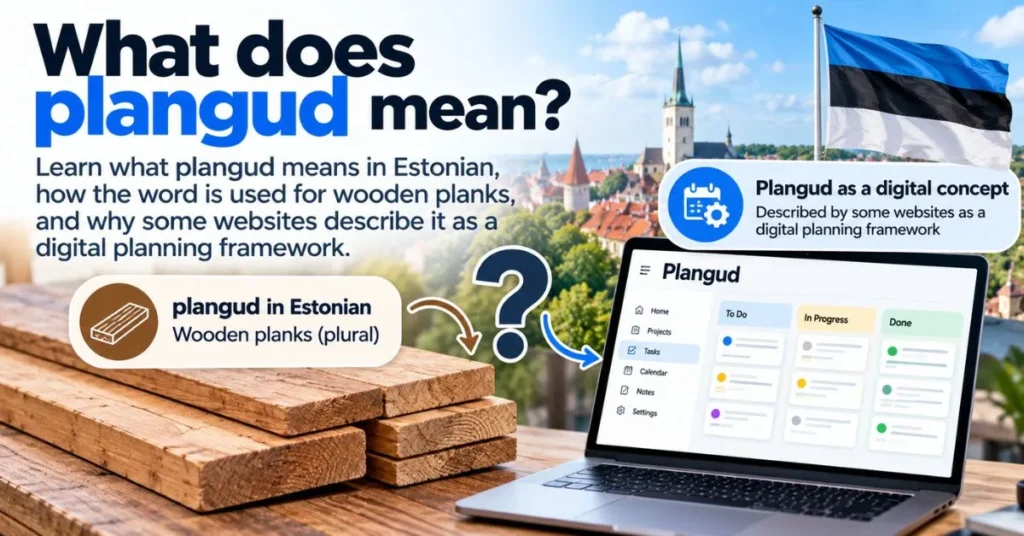
The word plangud can lead to two very different subjects online. In Estonian, it is an ordinary plural noun referring to wooden planks or thick boards. On several English-language websites, however, the same word is presented as the name of a planning method, productivity concept or digital platform.
Those meanings should not be treated as equally established. The timber meaning is supported by authoritative Estonian dictionaries and normal language use. The planning-related meaning appears to be a much newer form of website branding, and the available public evidence does not show that it is a recognized general term or a mature software category.
This guide explains the verified meaning of plangud, its grammar and common timber contexts. It also examines the newer web claims so readers can understand what they are looking at when the keyword appears in search results.
Quick Answer
Plangud is the nominative plural of the Estonian noun plank. In English, it normally translates as planks, thick boards or, depending on context, pieces of sawn timber.
The singular form is plank. If an Estonian timber seller, builder or product description uses plangud, the text is probably discussing multiple wooden planks. The exact English translation may vary with the construction, furniture, fencing or marine context.
Some websites use Plangud as a brand-like name for planning and productivity content. That usage exists online, but it should not be mistaken for the dictionary meaning of the Estonian word.
What Does Plangud Mean?
In its established linguistic sense, plangud means more than one plank. A plank is a relatively thick, elongated piece of sawn wood. It may be used as a raw building material or processed further for a specific project.
English does not always divide timber products into exactly the same categories as Estonian. Depending on the sentence, translator and regional vocabulary, plangud may appear in English as:
- planks;
- thick boards;
- timber boards;
- sawn timber;
- wooden boards.
“Planks” is usually the clearest direct translation. “Boards” can work in a general description, but it may lose the suggestion of thickness carried by the Estonian noun. A precise technical translation should therefore consider the product dimensions and intended use rather than relying on a single word in isolation.
Plangud in Estonian Grammar
Estonian changes noun endings according to number and grammatical case. This is why a reader may encounter several forms built from the same word.
| Form | Grammatical role | Practical English sense |
|---|---|---|
| plank | nominative singular | a plank |
| plangu | genitive singular | of a plank; also the stem used in several forms |
| planku | partitive singular | some or part of a plank, depending on the sentence |
| plangud | nominative plural | planks |
| plankude | genitive plural | of the planks |
| planke | partitive plural | planks in a partitive construction |
| plankudest | elative plural | from or about the planks |
The ending cannot always be translated word for word because Estonian cases often express relationships that English handles with prepositions or sentence structure. The important point for keyword research is that plangud is specifically a plural form, not the base dictionary form.
Capitalization also matters. Lowercase plangud is the ordinary Estonian noun. Capitalized Plangud may appear at the beginning of a sentence or be used deliberately as a website, project or brand name. Capitalization alone does not create a new dictionary meaning.
How the Word Is Pronounced
For an English speaker, a rough approximation is “PLAHN-good,” with the stress at the beginning. That approximation is only a guide. Estonian vowel length and consonant duration carry distinctions that English spelling does not reproduce neatly.
In careful language learning, it is better to listen to a native recording and imitate the complete word than to depend on an English respelling. The letters are pronounced consistently by Estonian standards, but an English reader may otherwise give the final syllable too much stress.
Where Plangud Are Used
Wooden planks are basic materials rather than finished products with one fixed purpose. Their suitability depends on wood species, dimensions, moisture content, grading, surface finish and treatment.
Common contexts include:
- general carpentry and joinery;
- fences, gates and outdoor screens;
- floors, steps and platforms when the product is suitable for that application;
- shelves, benches, tables and other furniture;
- cladding and decorative interior work;
- temporary workshop fixtures and packaging;
- boatbuilding or marine planking when an appropriate species and specification are used.
The word by itself does not prove that a plank is structural, weather-resistant, food-safe or suitable for direct ground contact. Those properties must be established from the product specification.
Plangud in Construction
In building work, planks may serve as components, working surfaces or material that will be cut into smaller pieces. A buyer needs more information than the noun alone provides.
Dimensions are the first consideration. Nominal dimensions may differ from the finished measurements after drying and planing. A project that depends on close tolerances should use actual finished dimensions rather than a broad product label.
Strength is another separate issue. Visual appearance does not establish load-bearing capacity. Structural timber should have the grading, documentation and dimensions required by the applicable design and local building rules. A decorative plank should not be substituted for a structural component simply because it looks solid.
For exterior projects, durability and water management matter. Even naturally durable or treated wood benefits from a design that allows drainage, ventilation and drying. End grain, fastener holes and horizontal surfaces often absorb moisture more readily than protected vertical faces.
Plangud for Fences and Outdoor Projects
The Estonian singular plank can also occur in vocabulary connected with fences, so the surrounding sentence deserves attention. In a timber listing, plangud generally refers to planks as material. In a property description or broader passage, related words may refer to a plank fence or barrier.
For an outdoor purchase, check:
- whether the wood species is appropriate for exterior exposure;
- whether preservative treatment is present and what use class it covers;
- whether the timber may contact soil or remain above ground;
- whether the boards are dry enough for installation;
- whether movement gaps are needed;
- whether the fasteners are compatible with the wood and treatment chemicals;
- whether cut ends require additional protection.
Wood expands and contracts as its moisture level changes. Fixing wide boards too tightly can encourage cupping, splitting or buckling. The appropriate gap and fixing pattern depend on the board profile, moisture condition, local climate and project design.
Plangud in Furniture and Interior Work
Furniture makers may choose planks for their width, grain and visual character. A rough-sawn plank can be flattened, thicknessed and cut into components, while a planed plank may already be close to its final size.
Interior material should be acclimated to the space in which it will be used. Bringing cold or damp timber directly into a heated room and assembling it immediately can produce movement later. The time required depends on the starting moisture content, plank thickness, airflow and indoor conditions.
Defects are not always undesirable. Knots, color changes, checks and irregular grain may be decorative features in a rustic table but unacceptable in a precisely fitted cabinet part. Quality is therefore connected to the intended use, not just to a perfectly uniform appearance.
Plangud in Boatbuilding
Planking is also a recognized part of wooden boat construction. In that setting, translating plangud simply as “boards” can be too vague. The pieces may form or repair part of a hull, deck or other assembly.
Marine work requires project-specific decisions about species, grain orientation, moisture, fastening, joint design and protective systems. The presence of the word plangud in a product description does not by itself make the wood marine grade. Anyone repairing a hull or another safety-critical component should follow the vessel’s design requirements and seek experienced advice where necessary.
Rough-Sawn and Planed Plangud
Two planks sold under the same general name can require very different amounts of preparation.
| Condition | Typical characteristics | What the buyer should check |
|---|---|---|
| Rough-sawn | Saw marks, variable surface texture and possible dimensional allowance | Actual size, drying condition and material available for flattening |
| Planed | Smoother faces and more consistent finished dimensions | Final thickness, edge treatment and remaining defects |
| Kiln-dried | Dried under controlled conditions | Target moisture range and suitability for the destination environment |
| Air-dried | Dried naturally over time | Current moisture, drying defects and whether further conditioning is needed |
| Treated | Preservative applied for specified exposure conditions | Treatment type, permitted applications and handling instructions |
| Untreated | No preservative treatment represented | Natural durability and the need for finishing or protection |
A smooth surface is not proof that a plank is dry, straight or suitable for the job. Similarly, rough material is not automatically lower quality; it may simply be earlier in the manufacturing process and leave more freedom for custom sizing.
Choosing the Right Wood Species
The word plangud says nothing about species. Estonian and regional sellers may offer softwood or hardwood planks, each with different working properties and typical uses.
Softwoods are often economical and widely available for construction and general carpentry. Hardwoods may be selected for wear resistance, appearance or particular furniture applications. These are broad categories, not performance guarantees.
When comparing species, consider:
- intended indoor or outdoor exposure;
- strength and stiffness requirements;
- resistance to decay and insects;
- weight;
- ease of machining and fastening;
- tendency to split or move;
- compatibility with finishes and adhesives;
- appearance, grain and color;
- availability in the required size;
- documented origin and certification requirements.
Local names can create confusion, especially when translated automatically. For a significant purchase, confirm the botanical or standardized trade name rather than relying only on a translated common name.
Moisture Content and Dimensional Stability
Wood is hygroscopic: it gains and loses moisture in response to the surrounding air. As its moisture content changes, its dimensions change as well. Movement is usually greater across the grain than along it.
This affects flooring, furniture, doors, tabletops, fences and nearly every project using broad planks. Material that is too wet at installation may shrink and open gaps as it dries. Material that is much drier than its destination may swell after installation.
A moisture meter can help assess a shipment, but readings must be interpreted correctly for the species, meter type and plank thickness. Sampling several boards and several positions is more informative than taking one surface reading. For demanding work, the target should be based on the expected service environment and the relevant trade guidance.
How to Inspect Plangud Before Buying
A practical inspection should cover more than color and surface smoothness.
First, sight along the length to detect bow, crook and twist. A small amount of distortion may be removable during machining, but severe twist can consume much of the usable thickness.
Second, examine both faces, both edges and the ends. Look for splits, deep checks, loose knots, insect damage, fungal decay, resin pockets and mechanical damage. Some defects are cosmetic; others reduce usable yield or strength.
Third, measure rather than assume. Check length, width and thickness at several points. If the plank will be machined flat, make sure there is enough material to reach the required final dimensions.
Fourth, ask how the timber was dried and stored. Staining, uneven color or surface mold can indicate poor storage, although appearance alone does not determine the full condition of the wood.
Finally, verify documentation when the application requires graded, treated or certified timber. A seller’s general category name should not replace the specific evidence needed for regulated or safety-critical work.
How to Store Wooden Planks
Poor storage can damage sound timber before a project begins. Planks should generally be supported at regular intervals on level bearers and kept away from soil or standing water. Stickers placed between layers promote airflow, but they should be aligned vertically so the stack remains evenly supported.
Protect the stack from direct rain while allowing ventilation. Completely sealing damp timber under an impermeable cover can trap moisture. Very uneven sun or heat may also encourage checking and distortion.
Heavy stacks can shift or collapse, so they should be stable and placed where children, vehicles and routine work will not disturb them. Long pieces that project into a walkway create an additional hazard.
Safe Handling and Machining
Woodworking risks include sharp tools, kickback, noise, dust, heavy lifting and hidden metal. Inspect reclaimed or previously used planks for nails, screws and other embedded objects before machining.
Use tools with suitable guards and extraction, and follow the manufacturer’s instructions. Eye and hearing protection are common workshop essentials. Dust control is particularly important because fine wood dust can irritate the respiratory system, and exposure risks vary among species.
Treated wood requires attention to its product instructions. Do not assume that offcuts or sawdust can be burned or disposed of like untreated clean wood. The permitted handling and disposal method depends on the treatment and local rules.
Why Plangud Appears in Planning Searches
The spelling resembles the English word “plan,” which makes Plangud a plausible invented brand name for productivity content. Several recent web pages capitalize the word and describe it as a system for turning goals into manageable actions. One site presents itself as a “digital planning framework.”
That does not alter the established Estonian meaning. It demonstrates that the same character string can function as both a normal word in one language and a chosen name in another context.
There is also a circularity problem in low-quality search content. One website publishes an unsupported definition, other pages repeat it, and the repetition can make the claim look established. Search visibility is not the same as linguistic authority or independent product evidence.
Is Plangud a Recognized Planning Method?
Based on the publicly visible evidence reviewed for this article, Plangud should not be presented as a recognized planning methodology. The planning-related pages use broad ideas such as breaking goals into tasks, setting priorities, collaborating and tracking progress. Those are familiar project-management practices, but attaching a new label to them does not establish a distinct method.
A recognized methodology normally has some combination of a defined origin, stable principles, documented processes, practitioner literature, training standards, independent adoption and a history that can be verified. The pages reviewed do not provide that level of support for Plangud as a method.
Readers can still find the generic advice useful. The issue is attribution: common planning practices should not be treated as proof that the term itself has an established professional definition.
What Is the Website Called Plangud?
The dot-com site using the name currently describes itself in planning-platform language. Its visible pages, however, function primarily as a broad WordPress publication. The site carries articles across unrelated topics, including technology, people, consumer subjects and general informational content. Its contact material also discusses guest posts, backlinks and sponsored content.
Those observations do not prove that the site is illegitimate. They do mean that readers should distinguish a publication’s branding statement from evidence of an operational software product.
| Claim or impression | Publicly observable evidence | Cautious conclusion |
|---|---|---|
| Plangud is a modern planning platform | Marketing-style wording appears on the homepage | This is a self-description, not independent verification |
| Teams can use powerful planning tools | Public product documentation and a clearly demonstrated application were not identified in the reviewed pages | Do not assume a usable software suite exists without further evidence |
| Plangud is comparable to established project tools | A site article makes comparisons with familiar platforms | A publisher’s own comparison does not demonstrate equivalent features or adoption |
| Plangud is a general productivity concept | Several recent articles repeat planning language | Repetition across low-authority pages does not establish a recognized definition |
| Plangud means wooden planks in Estonian | Authoritative Estonian dictionary material records the form | This is the verified linguistic meaning |
The dot-net site using the same name is also a general-interest publication. One of its articles describes Plangud as a planning concept, but that page is not an authoritative language source and does not establish the history of a formal methodology.
Is Plangud an App or Software Product?
No clear basis was found for describing Plangud as an established software application with a verified feature set. A genuine software evaluation would normally examine items such as:
- an accessible product interface or demonstrable workflow;
- official technical or user documentation;
- transparent pricing or licensing terms;
- supported platforms and system requirements;
- privacy and security information relevant to stored data;
- release history and support channels;
- identifiable customer evidence or independent reviews.
Without those elements, claims about dashboards, integrations, artificial intelligence, real-time collaboration or analytics should be treated as unverified unless the operator provides a working product and supporting documentation.
This conclusion is deliberately narrow. A site can change, and a product could be launched later. It simply means that readers should not infer a mature application from the current marketing language alone.
Plangud Is Not PlanGrid
Plangud can be mistyped or mentally associated with similarly named planning products. It should not be confused with PlanGrid, a construction-document application associated with Autodesk, or with unrelated planner and scheduling apps whose names begin with “Plan.”
When evaluating a search result, check the exact spelling, publisher and product documentation. A one-letter difference can lead to a completely different company, service or language term.
How to Evaluate Claims About Plangud
Use a simple evidence hierarchy:
- For the meaning of the Estonian word, prefer the Estonian Language Institute and established dictionaries.
- For a timber product, rely on the seller’s exact species, dimensions, moisture, grade, treatment and certification information.
- For claims about a website, separate what the operator says from what the site visibly provides.
- For a software product, look for a working interface, documentation, terms, privacy information and independent evidence.
- For a supposed planning methodology, look for a documented origin, stable framework and adoption beyond websites repeating the same definition.
This approach avoids two opposite mistakes: dismissing a valid Estonian word because English search results look unfamiliar, and accepting a newly coined marketing definition as if it were long-established terminology.
Verified and Unverified Claims at a Glance
| Statement | Status | Reason |
|---|---|---|
| Plangud is an Estonian plural noun | Verified | Recorded in authoritative Estonian language resources |
| The singular form is plank | Verified | Supported by dictionary morphology |
| The ordinary English meaning is “planks” | Verified | Consistent with dictionary definitions and examples |
| Plangud is a recognized universal planning framework | Not established | No authoritative origin or broad independent adoption identified |
| Plangud is a mature collaboration application | Not established | Marketing wording was visible, but sufficient public product evidence was not found |
| Every item sold as plangud is structural timber | False as a general assumption | Suitability depends on grading, dimensions and documentation |
| Every plank is suitable outdoors | False as a general assumption | Species, treatment, design and exposure determine suitability |
Translation Tips for Buyers and Researchers
If plangud appears in an Estonian product listing, capture the whole description before translating it. Nearby words may identify the species, treatment, moisture condition, surface finish or use.
Numbers are especially important. Confirm whether dimensions are expressed in millimetres and whether they describe rough or finished material. Also determine whether the price is per piece, linear metre, square metre or cubic metre. These commercial units are not interchangeable.
Machine translation can provide a first pass, but a professional or technically experienced translator is advisable for contracts, structural specifications, customs documents and safety instructions. The risk in those situations comes less from the word plangud itself than from the details surrounding it.
Conclusion
The clearest, best-supported meaning of plangud is the Estonian plural of plank: wooden planks or thick boards. It appears naturally in timber, construction, furniture, fencing and marine contexts, with the exact translation depending on the surrounding text.
The newer planning-related usage should be handled more cautiously. It reflects website branding and recent online content rather than an established dictionary meaning or a clearly verified professional methodology. The dot-com site describes itself as a planning platform, but its visible public presence resembles a broad WordPress publication, and the evidence reviewed does not justify assuming a mature software product.
For language questions, trust authoritative Estonian dictionaries. For timber purchases, verify the actual material specification. For digital-product claims, look beyond the name and require concrete product evidence.
Frequently Asked Questions
What does plangud mean in English?
Plangud normally means “planks” in English. “Thick boards” or “sawn timber” may fit some contexts, but the full sentence and product specification should guide the final translation.
What is the singular of plangud?
The nominative singular is plank. Plangud is the nominative plural.
Is plangud an Estonian word?
Yes. It is an established Estonian noun form recorded by authoritative Estonian language resources.
Does plangud mean a productivity system?
Not in its established dictionary sense. Some recent websites use Plangud as a name for planning or productivity content, but that usage is not supported as a recognized general definition.
Is Plangud a project-management app?
The reviewed dot-com site uses planning-platform language, but sufficient public evidence of a mature software product was not identified. Check for a working application, documentation, pricing, privacy information and independent reviews before treating it as one.
Is Plangud the same as PlanGrid?
No. PlanGrid is a separate construction software name. The terms should not be used interchangeably.
Are plangud always made from one type of wood?
No. The word describes multiple planks, not a particular species. A product listing should specify the wood.
Can plangud be used outdoors?
Some wooden planks are suitable for outdoor projects, but the word alone does not confirm that. Check species, treatment, use class, design and exposure conditions.
How can I tell whether a plank is structural?
Look for the required strength grading and documentation for the intended application. Appearance alone is not enough.
Why do search results give different definitions of plangud?
The term is both an Estonian word and a name adopted by several English-language websites. Some pages repeat an unsupported planning definition, while authoritative dictionaries document the timber meaning.

Rob Kent is the editorial pen name used by the owner and editor of Kentfaith.de. He manages topic selection, research, fact-checking, editing and publication across the website. His practical experience includes search engine optimization, website management and online content publishing. Articles published under this name are reviewed for names, dates, relationships and current information, with important factual claims supported by reputable sources.