
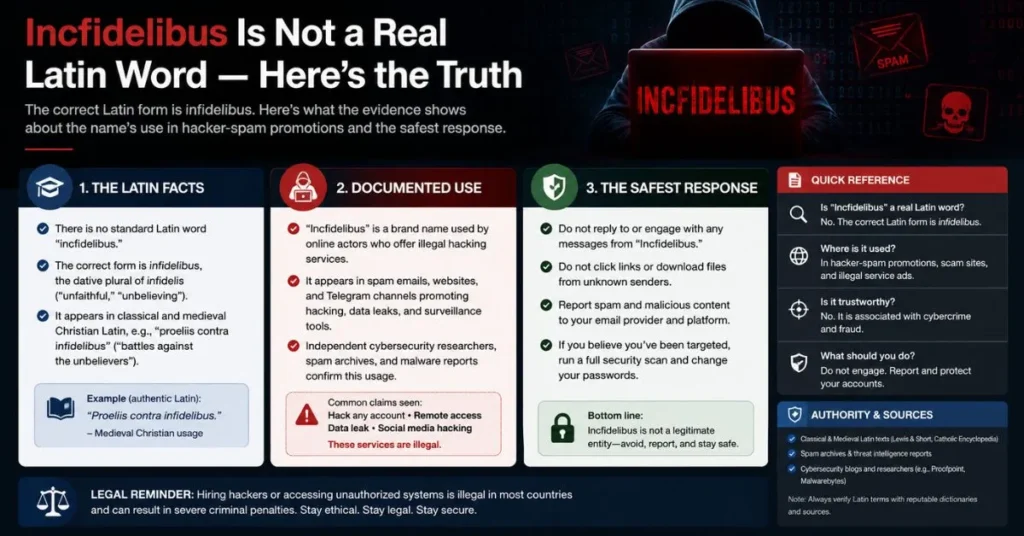
Quick Answer
Incfidelibus is not a standard Latin word. The valid Latin form is infidelibus, the dative or ablative plural of infidelis, an adjective meaning “unfaithful,” “disloyal,” or, in some religious contexts, “unbelieving.” Its exact English translation depends on the sentence.
Online, Incfidelibus has also been used as a name or handle in spam-style comments and pages advertising phone, email, and social-media hacking. Public examples can be traced to at least March 2018. Those pages document the claims being advertised; they do not verify the identity of the operator, the legality of the service, or whether any promised service was genuine.
The word itself is not malware and searching for it does not hack a device. However, an unsolicited offer to access another person’s phone or account should be treated as high risk. Do not pay, share credentials, install software, or follow instructions from the advertiser.
| Question | Evidence-based answer |
| Is “incfidelibus” correct Latin? | No standard Latin entry was found with the extra c. |
| What is the correct form? | Infidelibus. |
| What does infidelibus mean? | Dative or ablative plural of infidelis; possible translations include “to/for the unfaithful” or “with/by/from the unfaithful,” depending on context. |
| What is Incfidelibus online? | A spelling used as a handle in public “hire a hacker” promotions and comment spam. |
| Is every use of the name a proven scam? | No. The evidence supports caution, not a blanket allegation about every person, message, or present-day website using the word. |
| Is it a secret code, philosophy, or ancient order? | No credible primary source supports those claims. |
What Is Incfidelibus?
There are three separate subjects behind this search term, and many pages combine them incorrectly:
- The spelling “incfidelibus” — a nonstandard form with an extra c.
- The genuine Latin word infidelibus — a normal inflected form of infidelis.
- The online name “Incfidelibus” — a handle historically used to advertise alleged hacking and phone-spying services.
That distinction matters. The existence of a similar Latin word does not give an online service credibility. Conversely, the suspicious way a handle has been marketed does not change the grammar of the genuine Latin term.
Search results also contain recent articles that describe Incfidelibus as a philosophy about trust, identity, loyalty, or moral responsibility. We found no dated book, academic paper, historical organization, dictionary entry, or named originator establishing such a concept. Those descriptions should therefore be treated as unsupported reinterpretations, not history.
Is Incfidelibus a Real Latin Word?
Not in the spelling shown. The recognized word is infidelibus, without the c.
The base adjective infidelis, infidele means unfaithful, treacherous, or disloyal; later and religious usage can carry the sense of unbelieving. Latin reference material identifies infidelibus as the dative or ablative plural of that third-declension adjective. The ending therefore expresses grammatical function rather than creating a new concept. See the lexical entries for infidelis and infidelibus, alongside Dickinson College’s Latin case-ending reference.
| Latin form | Grammatical role | Possible English sense |
| fidelis | Base adjective | faithful, loyal, dependable |
| infidelis | Base adjective with negative prefix | unfaithful, disloyal; sometimes unbelieving |
| infidelibus | Dative or ablative plural | to/for, with/by/from the unfaithful or unbelieving |
| incfidelibus | Nonstandard spelling | No fixed Latin meaning established |
An isolated inflected Latin word does not always have one neat English translation. The surrounding preposition, noun, verb, and sentence determine whether infidelibus should be rendered as “to,” “for,” “with,” “by,” or “from” a plural group.
The safest conclusion is simple: Incfidelibus is most plausibly a misspelling, altered handle, or invented spelling based on infidelibus. There is not enough evidence to say who first inserted the c or why. Claims that it began as an optical-character-recognition error are possible but unproven.
Where Did the Online Name Come From?
The earliest public example located during this review is not an ancient text or philosophical work. It is a comment posted on an unrelated travel blog.
On March 5, 2018, a commenter using an Incfidelibus email address placed a promotional message beneath a post about winter in Bavaria. The comment advertised access to phones, social-media accounts, email, websites, and other targets. The unrelated subject matter and promotional wording are consistent with comment spam. The original comment remains visible on the <a href=”https://justbluedutch.com/2018/02/11/tour-guide-my-town-in-winter/” rel=”nofollow noopener”>public blog page</a>.
By 2019, a WordPress site using the same name was publishing posts about accessing WhatsApp, Snapchat, WeChat, and mobile phones. A separate author archive reproduced titles and dates for numerous posts attributed to “incfidelibus.” The <a href=”https://incfidelibus.wordpress.com/about/” rel=”nofollow noopener”>public WordPress About page</a> directly advertised alleged phone, email, and social-media hacking, while the <a href=”https://checkmatetracking.com/author/incfidelibus/” rel=”nofollow noopener”>public author archive</a> lists posts dated throughout 2019.
| Date | What the public record shows | What it does not prove |
| March 5, 2018 | An Incfidelibus-branded comment advertised hacking services under an unrelated travel article. | The poster’s real identity or the truth of the service claims. |
| July–December 2019 | Public pages and an author archive promoted or listed phone and messaging-account hacking content. | That any advertised intrusion succeeded or was lawful. |
| August 2026 | Incfidelibus.com currently presents itself as a general technology-content site and has published an explanation of the keyword. | That its present publisher is the same person or organization behind every earlier use of the name. |
The old WordPress About page linked to Incfidelibus.com as its “main” website. That establishes a historical link between the page and the domain name at that time. It does not establish uninterrupted ownership. Domains can expire, change hands, or be repurposed, so the current publisher should not be identified as the old operator without independent ownership records.
Is Incfidelibus Connected to Scam Emails?
Several recent articles say the word appears in mass sextortion or “your webcam was hacked” emails. During this review, we did not find an FBI, FTC, Europol, security-vendor, court, or established news report documenting a campaign under the exact name Incfidelibus. Nor did the reviewed articles provide a verifiable sample with full headers or a traceable incident report.
That does not prove such an email has never existed. It means the claim is unverified and should not be repeated as settled fact.
The evidence that can be checked is narrower and stronger: the name appeared in promotional comments and pages offering alleged unauthorized access. That is enough to justify caution, but it is different from proving a named email-extortion campaign.
| Online claim | Verdict | Reason |
| “Incfidelibus is a Latin word.” | Misleading | Infidelibus is Latin; the extra c is nonstandard. |
| “It is an ancient philosophy about loyalty.” | Unsupported | No credible historical or academic source was found. |
| “It is definitely a documented sextortion-email campaign.” | Unverified | Recent pages repeat the idea, but authoritative incident evidence was not found. |
| “The handle was used to promote hacking services.” | Documented | Public comments, pages, and dated post listings support this. |
| “The advertised hacker was legitimate.” | Not established | Promotional claims are not independent proof. |
| “The current domain must have the same owner as in 2018–2019.” | Not established | Historical linking does not prove current ownership continuity. |
Is Incfidelibus a Scam?
A word cannot itself be a scam. The more useful question is whether a particular message, profile, or service using the name is trustworthy.
The historical pages make extraordinary offers: access to another person’s private phone, email, or social-media account. They do not provide independently verifiable company registration, named professional credentials, a transparent legal authorization process, or credible third-party evidence that the promised work was legitimate. That combination makes such an offer high risk.
Watch for these warning signs:
| Red flag | Why it matters |
| A promise to enter someone else’s account without consent | The proposed act may be illegal and harmful. |
| Contact through a generic email address or comment section | It gives the customer little verified identity or accountability. |
| Guaranteed access to WhatsApp, email, or a phone | Real security work depends on written authorization and a defined scope; blanket guarantees are not credible. |
| Requests for cryptocurrency, gift cards, or an irreversible transfer | Recovery may be difficult or impossible. |
| Requests for passwords, recovery codes, identity documents, or remote access | These can enable account takeover or identity theft. |
| Urgency, secrecy, or instructions not to contact the platform or police | Pressure reduces the chance that a target will verify the story. |
This assessment does not accuse every current user of the spelling of fraud. It explains why the documented promotional pattern does not meet a reasonable standard of trust.
For a comparable example of separating platform claims from verifiable safety information, read Kentfaith.de’s VyvyManga safety guide. Our BrumeBlog com explainer shows a similar research method for an ambiguous web keyword, while the Guide archive collects more fact-checked explainers.
The Legal and Ethical Problem With “Hire a Hacker” Offers
Legitimate penetration testers work with the system owner’s explicit authorization, a written scope, defined dates, and agreed reporting procedures. A stranger promising to secretly enter a spouse’s phone or another person’s account is describing something fundamentally different.
In the United States, the Computer Fraud and Abuse Act covers various forms of knowingly accessing a computer without authorization or exceeding authorized access. The exact application depends on the facts; the statutory text is available at 18 U.S.C. § 1030, and the U.S. Department of Justice publishes its CFAA prosecution policy.
For Kentfaith.de’s German context, Section 202a of the German Criminal Code addresses unauthorized acquisition of specially protected data. Laws and penalties vary by jurisdiction, so a reader facing a real incident should consult local law enforcement or a qualified lawyer rather than an anonymous online operator.
The practical rule is universal: do not hire someone to access a device or account unless the owner has given clear legal authorization. Ethical security testing protects the owner. Covert access, stalking, credential theft, and interception target another person’s privacy.
What to Do If Someone Contacts You Using This Name
If an Incfidelibus-branded account or any other “hacker for hire” profile contacts you:
- Do not reply or negotiate. A response confirms that your address or account is active.
- Do not click links, open attachments, or install an app. The offer may be a route to phishing, malware, or remote access.
- Do not send passwords or verification codes. A legitimate support representative will not need your one-time authentication code.
- Save evidence safely. Keep screenshots, usernames, message dates, payment instructions, and transaction references without continuing the conversation.
- Report the profile or message to the platform. Use the platform’s phishing, fraud, spam, or abuse channel.
- If a crime or financial loss occurred, contact the appropriate authority. U.S. readers can submit cyber-enabled fraud reports through the FBI’s Internet Crime Complaint Center. Readers elsewhere should use their national cybercrime reporting service or local police.
An unfamiliar word in a message is not proof that your device has been compromised. Judge the message by its links, requests, evidence, and behavior—not by how technical or mysterious its name sounds.
What to Do If You Paid or Shared Information
Act quickly, but do not pay a second person who claims they can recover the money for an upfront fee.
- Contact the payment provider or bank immediately. Explain that the transaction may involve fraud and ask whether it can be reversed. The U.S. Federal Trade Commission provides payment-specific steps in What To Do if You Were Scammed.
- Change exposed passwords from a clean device. Use a unique password for every important account.
- Sign out of other sessions and enable two-factor authentication. Also verify recovery email addresses, phone numbers, forwarding rules, and connected apps. The FTC’s account-recovery guidance provides a useful checklist.
- Call the real company through its official website or app. Do not use a number supplied by the suspicious contact.
- Monitor financial and email accounts. Check for new payees, forwarding rules, unfamiliar logins, password-reset messages, or unauthorized transactions.
- If remote-access software was installed, disconnect the device and obtain help from a trusted security professional. Do not give the original contact another session.
What Website Owners Should Do About Incfidelibus Comment Spam
The 2018 example illustrates a wider SEO and security problem: a spammer can place unrelated, potentially harmful advertising beneath an innocent article.
Google classifies spammy blog comments as user-generated spam and recommends monitoring public content channels, using anti-abuse controls, and acting on suspicious material. Its guidance is available in Prevent user-generated spam on your site and the Google Search spam policies.
For WordPress sites:
- Open Comments and mark the entry as Spam rather than approving or replying to it.
- Go to Settings → Discussion and require moderation for first-time or all commenters where appropriate.
- Hold comments containing links, suspicious terms, or repeated contact details for review.
- Use a reputable anti-spam service and keep WordPress, the theme, and plugins updated.
- Close comments on old posts if they receive only automated submissions.
- Review already indexed pages for old spam that may still expose visitors to unsafe offers.
WordPress’s official documentation explains both comment moderation and the controls under Settings → Discussion.
Deleting or marking the spam does not harm the legitimate article. It removes content that the site owner did not create and should not endorse.
What About Incfidelibus.com Today?
As checked on August 13, 2026, <a href=”https://incfidelibus.com/” rel=”nofollow noopener”>Incfidelibus.com</a> displays a general technology-content site with recent posts. One current article describes the keyword as a Latin typo associated with scam emails. The present website therefore should not be described as a live hacker-for-hire service solely because an older WordPress page once linked to the domain.
At the same time, the current site provides little public information with which to verify ownership continuity, editorial identity, or the source for its exact “scam email” claim. Its own article is not independent evidence about the history of the name.
The responsible conclusion is:
- the domain was historically linked from an Incfidelibus-branded hacker-promotion page;
- its current visible content is different;
- the relationship between the current publisher and the earlier operator remains unverified; and
- readers should evaluate any request for personal information, payment, downloads, or account access on its own evidence.
conclusion
Incfidelibus is best understood as a nonstandard spelling with two documented associations: a likely alteration of the real Latin form infidelibus, and an online handle used in spam-style “hire a hacker” promotions.
The evidence does not support turning it into an ancient philosophy, a secret organization, or a confirmed named sextortion campaign. It also does not prove that every modern use of the word—or the current domain publisher—is fraudulent.
If the term appears only in a search result, it presents no special danger. If it appears in an offer to enter a phone, email, or social-media account, do not proceed. Avoid payment, protect your credentials, preserve evidence, and report the contact through legitimate channels.
Frequently Asked Questions
What does Incfidelibus mean?
Incfidelibus has no established meaning as a standard Latin word. It appears to be a misspelling or altered form of infidelibus and has also been used as an online handle.
What does infidelibus mean in Latin?
Infidelibus is the dative or ablative plural of infidelis. Depending on context, it can mean “to or for the unfaithful” or “with, by, or from the unfaithful.” Religious texts may use it in the sense of unbelievers.
Is Incfidelibus a real company?
We found public pages and accounts using the name, but no independently verified corporate identity behind the historical hacker-service promotions. A current website uses the domain, but continuity of ownership has not been established.
Is Incfidelibus malware?
No evidence shows that the word itself names a specific malware family. A word in a message cannot infect a device by itself. The risk comes from clicking a malicious link, opening an attachment, installing software, sharing credentials, or sending money.
Is Incfidelibus linked to scam emails?
Recent articles make that claim, but this review found no authoritative report documenting an exact Incfidelibus email campaign. Its use in comment spam and hacker-for-hire promotions is documented; a specific mass-email campaign is not.
Can I hire someone to check whether my partner is cheating?
You should not authorize secret access to another person’s phone or online accounts. If you need lawful investigative help, consult a licensed professional who explains the legal scope and does not promise unauthorized access.
Is it safe to visit Incfidelibus.com?
No article can guarantee a website’s future safety. At the time checked, it displayed general content, but its ownership history and some claims were not independently verified. Do not provide sensitive information, download software, or pay for a service without separate verification.
What should I do with an Incfidelibus comment on my WordPress site?
If it advertises hacking, spying, or unrelated services, mark it as spam and remove it. Then review Settings → Discussion, enable appropriate moderation, and check older posts for similar comments.
Sources and Verification
This article was fact-checked on August 13, 2026. Sources were selected to separate linguistic facts, observable public records, law, and safety advice.
- Infidelis — Latin Dictionary entry — lexical meaning.
- Infidelibus — Wiktionary Latin form and Dickinson College Commentaries: Latin case endings — morphology and grammatical case.
- <a href=”https://justbluedutch.com/2018/02/11/tour-guide-my-town-in-winter/” rel=”nofollow noopener”>JustBlueDutch public post and comments</a> — dated March 5, 2018 example of an unrelated Incfidelibus promotional comment. The linked comment is evidence of publication, not proof of the advertiser’s claims.
- <a href=”https://incfidelibus.wordpress.com/about/” rel=”nofollow noopener”>Public Incfidelibus WordPress About page</a> and <a href=”https://checkmatetracking.com/author/incfidelibus/” rel=”nofollow noopener”>Checkmate Tracking author archive</a> — observable historical promotions and dated post listings. Do not use the displayed contact details.
- 18 U.S.C. § 1030, U.S. Department of Justice CFAA policy, and German Criminal Code § 202a — primary legal references. This article is general information, not legal advice.
- FTC: What To Do if You Were Scammed and FTC: Recover a hacked account — consumer recovery steps.
- FBI Internet Crime Complaint Center — U.S. cybercrime and cyber-enabled fraud reporting.
- Google Search Central: Prevent user-generated spam and WordPress comment moderation — guidance for site owners.

Rob Kent is the editorial pen name used by the owner and editor of Kentfaith.de. He manages topic selection, research, fact-checking, editing and publication across the website. His practical experience includes search engine optimization, website management and online content publishing. Articles published under this name are reviewed for names, dates, relationships and current information, with important factual claims supported by reputable sources.