
Historical pricing note: This guide is built around U.S. manufacturer list prices and product information available during 2024. It does not treat temporary sale prices as regular prices. Retail prices, stock, firmware and support can change, so readers should confirm current details before buying.
Quick Answer
The Nothing Ear was the best all-round wireless-earbud package under $200 in 2024. Its $149 launch price included active noise cancellation, dual-device connection, wireless charging, an advanced equalizer and support for the LDAC and LHDC high-resolution Bluetooth codecs on compatible devices. It was not the longest-lasting or most rugged model in this comparison, but it combined the fewest major compromises.
The right alternative depended on the buyer. AirPods 4 with Active Noise Cancellation were the natural choice for iPhone users who disliked silicone ear tips. OnePlus Buds 3 delivered the strongest feature-to-price ratio at $99.99, while Soundcore Liberty 4 NC offered the longest manufacturer-claimed total battery life. Jabra Elite 8 Active stood out for strenuous workouts, and Samsung Galaxy Buds FE made the most sense inside the Galaxy ecosystem.
For more comparisons covering useful technology for creators and everyday users, browse Kentfaith.de’s Technology archive.
| Best for | Recommended earbuds | 2024 U.S. list price | Main reason |
|---|---|---|---|
| Best overall | Nothing Ear | $149 | Excellent mix of sound features, ANC, customization and charging options |
| Best for iPhone users | AirPods 4 with ANC | $179 | Open fit, H2 features and tight Apple integration |
| Best value under $100 | OnePlus Buds 3 | $99.99 | Dual drivers, adaptive ANC, multipoint and long battery life |
| Best battery and travel value | Soundcore Liberty 4 NC | $99.99 | Up to 50 hours total with ANC off and 40 hours with ANC on |
| Best for workouts | Jabra Elite 8 Active | $199 | IP68 earbuds, secure fit and strong ANC-on battery claim |
| Best for Samsung phones | Galaxy Buds FE | $99.99 | Galaxy Auto Switch, SmartThings Find and stable wingtip fit |
| Best for comfort and codec support | Sennheiser ACCENTUM True Wireless | $199.99 | Ergonomic design, aptX, LC3 and Qi charging |
| Best for mixed Apple and Android households | Beats Studio Buds + | $169.99 | Native features and device-finding support on both platforms |
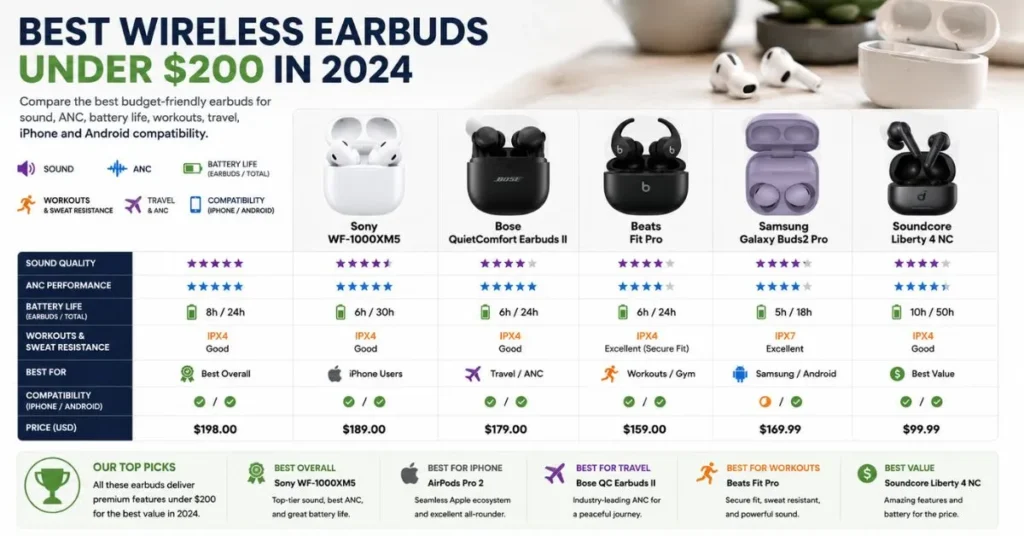
Featured-image caption: The eight best wireless earbuds under $200 compared for 2024, including options for creators, commuters, travellers and workouts.
Featured-image alt text: Nothing Ear, AirPods 4 with ANC, OnePlus Buds 3, Soundcore Liberty 4 NC, Jabra Elite 8 Active, Galaxy Buds FE, Sennheiser ACCENTUM True Wireless and Beats Studio Buds Plus.
Full Specification Comparison
| Model | 2024 U.S. list price | ANC | Claimed battery with ANC | Claimed maximum battery | Earbud resistance | Standout feature |
| Nothing Ear | $149 | Up to 45 dB | 5.2 hours; 24 with case | 8.5 hours; 40.5 with case | IP54 | LDAC, LHDC, advanced EQ and Qi charging |
| AirPods 4 with ANC | $179 | Yes | 4 hours; 20 with case | 5 hours; 30 with case | IP54 | Open-ear ANC and Apple H2 features |
| OnePlus Buds 3 | $99.99 | Up to 49 dB | 6.5 hours; 28 with case using AAC | 10 hours; 44 with case using AAC | IP55 | Dual drivers and swipe volume control |
| Soundcore Liberty 4 NC | $99.99 | Adaptive ANC 2.0 | 8 hours; 40 with case | 10 hours; 50 with case | IPX4 | Long battery life, LDAC and wireless charging |
| Jabra Elite 8 Active | $199 | Adaptive Hybrid ANC | 8 hours; 32 with case | Up to 14 hours; 56 with case after updates | IP68; case IP54 | Rugged construction and secure ShakeGrip fit |
| Samsung Galaxy Buds FE | $99.99 | Yes | 6 hours; 21 with case | 8.5 hours; 30 with case | IPX2 | Galaxy ecosystem features and wingtips |
| Sennheiser ACCENTUM True Wireless | $199.99 | Hybrid ANC | Up to 8 hours per charge; usage affects result | Up to 28 hours with case | IP54 | aptX, LC3, Auracast capability and Qi charging |
| Beats Studio Buds + | $169.99 | Yes | 6 hours; 24 with case | 9 hours; 36 with case | IPX4 | Native Apple and Android features |
Battery figures above are manufacturers’ laboratory claims, not Kentfaith measurements. Volume, codec, calls, ANC, spatial audio, fit, temperature and signal conditions can all reduce real-world endurance. An IP rating also does not make earbuds suitable for swimming, and water resistance can decline with normal wear.
Comparison-image caption: Manufacturer-claimed battery life and 2024 U.S. list prices for eight wireless earbuds costing less than $200.
Comparison-image alt text: Bar chart comparing 2024 prices and maximum total battery life for eight wireless earbuds under 200 dollars.
How This 2024 List Was Selected
This is a specification-based buying guide, not a claim that Kentfaith performed laboratory measurements on all eight products. Each model had to meet three basic conditions: it had to be available in the United States during 2024, carry a regular manufacturer price below $200 and offer a meaningful advantage for a recognizable type of user.
The comparison gives priority to features that matter away from a quiet desk:
- Fit and durability: Can the earbuds remain useful during a long editing session, location shoot, commute or workout?
- Noise control: Is ANC included, and is there a transparency or ambient-listening option?
- Battery: Can the earbuds cover a working day, and how much extra power does the case provide?
- Device compatibility: Do they work best with iPhone, Galaxy, OnePlus or a mixture of platforms?
- Controls and app support: Can users change volume, EQ, ANC and connections without unnecessary friction?
- Value: Does the product offer a clear advantage over cheaper alternatives without relying on a temporary discount?
Sound preference remains personal. Driver size, codec support and a manufacturer’s decibel claim do not by themselves prove that one pair sounds better. Ear shape and tip seal can also change bass response and ANC dramatically. The rankings below are therefore editorial recommendations derived from documented features and intended use—not invented test results.
1. Nothing Ear — Best Wireless Earbuds Under $200 Overall
Nothing launched the 2024 Ear at $149, positioning it comfortably below the premium earbuds that often crossed $200. Its specification sheet was unusually complete for that price: an 11 mm ceramic driver, adaptive ANC rated by Nothing at up to 45 dB, dual-device connection, Qi wireless charging and an advanced eight-band equalizer in the Nothing X app.
It was also the most flexible option for listeners who cared about Bluetooth codecs. Nothing documented support for both LDAC and LHDC 5.0 on compatible devices, alongside the standard options used by ordinary phones. Those high-resolution modes were most useful to Android listeners with compatible hardware and high-quality source files; iPhone users remained limited to Apple-supported Bluetooth codecs, so the logo on a codec list should never be treated as a universal sound upgrade.
The official battery claim was 8.5 hours from the earbuds and 40.5 hours with the case when ANC was disabled. With ANC or Transparency mode active, those numbers fell to 5.2 and 24 hours. That reduction prevented the Nothing Ear from winning the battery category, but wireless charging, quick charging and multipoint connectivity made it easy to live with during mixed phone-and-laptop days.
For Kentfaith readers, the appeal is versatility. A photographer can connect to a laptop while editing, switch to a phone call and adjust the EQ without buying into one phone brand. The IP54 rating provides protection against dust and splashes, but it is not permission to swim or leave wet earbuds in the case.
Best for: Creators and everyday listeners who want customization, modern codecs and convenient charging without approaching $200.
Skip it if: Maximum ANC-on battery life or extreme workout durability matters more than sound customization.
Image caption: Nothing Ear combines a transparent design with adaptive noise cancellation, wireless charging and detailed app-based sound controls.
Image alt text: Black Nothing Ear wireless earbuds beside their transparent charging case.
2. AirPods 4 with Active Noise Cancellation — Best for iPhone Users
Apple introduced AirPods 4 in September 2024 and priced the ANC version at $179. Their defining feature was not a codec or oversized battery; it was the combination of noise cancellation and an open design without silicone tips. That made them attractive to iPhone users who found sealed in-ear models uncomfortable.
The H2-based feature set included Active Noise Cancellation, Transparency mode, Adaptive Audio, Conversation Awareness, Voice Isolation and Personalized Spatial Audio. The charging case supported USB-C, Qi-certified wireless chargers and an Apple Watch charger, while a built-in speaker helped with Find My.
The trade-off was battery life. Apple claimed up to four hours per charge and 20 hours with the case when ANC was enabled. With noise control off, those figures rose to five and 30 hours. That was enough for commuting and shorter creative sessions, but well behind the Soundcore, OnePlus and Jabra claims.
Open-fit ANC also needs realistic expectations. Because the earbuds do not seal the ear canal with silicone, outside sound can enter more freely. Some users will prefer that airy feeling and improved awareness; others will get better low-frequency isolation and bass consistency from a correctly fitted sealed earbud.
AirPods 4 work as Bluetooth headphones with non-Apple devices, but Apple states that functionality may be limited. Their value is therefore greatest for people already using an iPhone, iPad and Mac.
Best for: iPhone creators and commuters who want Apple convenience without silicone ear tips.
Skip it if: You use Android, need the longest battery life or want a firm in-ear seal for stronger passive isolation.
Image caption: AirPods 4 brought active noise cancellation and adaptive audio to Apple’s open-fit earbud design in 2024.
Image alt text: Apple AirPods 4 with Active Noise Cancellation above their compact white charging case.
3. OnePlus Buds 3 — Best Value Under $100
At $99.99, the OnePlus Buds 3 offered one of the most aggressive specifications of 2024. Each earbud used a dual-driver arrangement with a 10.4 mm woofer and 6 mm tweeter. OnePlus also listed adaptive noise cancellation up to 49 dB, LHDC 5.0 support, Bluetooth 5.3, Google Fast Pair and Dual Connection.
The practical feature that separated them from many competitors was swipe-based volume control on the stems. Users could adjust volume without opening an app or reaching for the phone—useful when carrying a camera, walking through an airport or working at a desk.
Battery claims were strong for the price. Using AAC with ANC disabled, OnePlus stated up to 10 hours from the earbuds and 44 hours with the case. With ANC active, those figures became 6.5 and 28 hours. A 10-minute charge of the earbuds and case could provide up to seven hours of playback under the company’s test conditions.
The earbuds carried an IP55 rating for dust and water resistance, which made them more reassuring for outdoor use than models rated only against splashes. The case charged through USB-C and did not provide the Qi convenience offered by Nothing, Soundcore, Jabra and Sennheiser.
Although OnePlus phones unlock the smoothest brand-specific experience, the HeyMelody app extends customization to other compatible devices. LHDC benefits still depend on source-device support.
Best for: Buyers who want ANC, good endurance, physical volume access and high-resolution Android audio for around $100.
Skip it if: Wireless charging or deep Apple ecosystem integration is essential.
Image caption: OnePlus Buds 3 delivered dual-driver sound, adaptive ANC and long battery life at a $99.99 price in 2024.
Image alt text: Metallic gray OnePlus Buds 3 earbuds standing beside their oval charging case.
4. Soundcore Liberty 4 NC — Best Battery and Travel Value
The Liberty 4 NC was the endurance leader in this group according to manufacturer figures. Soundcore claimed 10 hours per charge and 50 hours with the case in normal mode. With ANC enabled, the stated figures were still eight and 40 hours. Turning on both LDAC and ANC reduced them to five and 25 hours, which demonstrates why battery comparisons must state the operating mode.
At $99.99, the feature list included Adaptive ANC 2.0, an 11 mm driver, LDAC, Bluetooth multipoint, Qi wireless charging and app-based controls. For a traveller moving between a phone and laptop, that mix delivered more practical value than simply chasing the highest audio specification.
Soundcore promoted noise reduction of up to 98.5 percent under its own test conditions. That number should not be read as a guarantee that 98.5 percent of every sound disappears. ANC performance changes with frequency, fit, ear shape and environment. The responsible takeaway is that Liberty 4 NC includes an adaptive system designed to respond to the user’s ear canal and surroundings.
Its IPX4 rating covers splashes but not dust, submersion or the more severe workout conditions addressed by the Jabra. That makes Soundcore the better choice for flights, trains, offices and long days, while Jabra remains the safer specialist for intense exercise.
Best for: Travellers, commuters and students who prioritize long battery life, wireless charging and multipoint connectivity.
Skip it if: You need an IP rating suitable for heavy rain, dust or high-sweat training.
Image caption: Soundcore Liberty 4 NC pairs adaptive noise cancellation with up to 50 hours of claimed total listening time.
Image alt text: Navy Soundcore Liberty 4 NC earbuds in an open charging case.
5. Jabra Elite 8 Active — Best for Workouts and Rugged Use
The original Jabra Elite 8 Active carried a $199 MSRP and was the durability specialist of the 2024 field. Jabra rated the earbuds IP68 and the case IP54, documented testing against MIL-STD-810H conditions and used its wing-free ShakeGrip material to improve stability.
Its official feature list also included Adaptive Hybrid ANC, Dolby Audio, six microphones, multipoint connectivity, Qi wireless charging and up to eight hours of playback with ANC enabled—32 hours including the case. Those figures made it suitable for a workout followed by a working day without requiring constant charging.
There is, however, an important buying caveat. In June 2024, Jabra’s parent company GN announced that it would gradually wind down the Elite and Talk product lines. GN said it would continue service and support for customers for several years, but the decision meant that the Elite 8 Active belonged to a product family without a continuing consumer-earbud roadmap. That did not erase the model’s ruggedness, but buyers had to weigh long-term ecosystem confidence and replacement availability.
For photographers working around dust, light rain or demanding outdoor environments, the resistance ratings were valuable. They still did not make the earbuds appropriate for swimming, and saltwater or liquid exposure should always follow Jabra’s care instructions.
Best for: Running, gym training, outdoor work and users who place durability above codec variety.
Skip it if: You want a product line with a clear future upgrade path or broad high-resolution codec support.
Image caption: Jabra Elite 8 Active uses an IP68-rated, secure-fitting design for workouts and demanding outdoor use.
Image alt text: Navy Jabra Elite 8 Active earbuds beside their compact charging case.
6. Samsung Galaxy Buds FE — Best for Samsung Galaxy Phones
Samsung’s $99.99 Galaxy Buds FE were less ambitious on paper than Nothing Ear or OnePlus Buds 3, but they were carefully targeted. The earbuds offered ANC, Ambient Sound, three microphones, interchangeable ear tips and wingtips, Galaxy Auto Switch and SmartThings Find.
The fit system was a major reason to choose them. Wingtips can provide additional stability for listeners whose earbuds loosen while walking, although comfort still depends on individual ear shape. Samsung claimed up to six hours from the earbuds and 21 hours total with ANC enabled. With ANC off, the figures increased to 8.5 and 30 hours.
Their limitations were equally clear. The IPX2 rating was the weakest in this comparison and offered only modest splash protection. Some ecosystem features were limited to compatible Samsung devices signed into the same Samsung account, and Samsung’s proprietary Scalable Codec did not create the same value for users outside the Galaxy family.
For a Galaxy phone owner who wanted affordable ANC and automatic switching among Samsung devices, those compromises could be reasonable. For a buyer using a mixed collection of phones and computers, the OnePlus, Soundcore, Nothing or Beats options were easier to justify.
Best for: Samsung Galaxy users who value Auto Switch, SmartThings Find and a wingtip-supported fit.
Skip it if: You need strong water resistance, wireless charging or platform-neutral multipoint use.
Image caption: Galaxy Buds FE offers affordable ANC, supportive wingtips and Samsung ecosystem features for $99.99.
Image alt text: Graphite Samsung Galaxy Buds FE earbuds with wingtips and their square charging case.
7. Sennheiser ACCENTUM True Wireless — Best for Comfort and Modern Codecs
Sennheiser launched the ACCENTUM True Wireless in May 2024 at $199.99—technically one cent below the limit. The company emphasized an ergonomic shape developed through in-ear research, four ear-tip sizes and 7 mm TrueResponse dynamic drivers manufactured at its Tullamore facility.
Connectivity was a strength. The earbuds supported Bluetooth 5.3, SBC, AAC, aptX and LC3, while Sennheiser described them as Bluetooth LE Audio and Auracast capable. Auracast availability depended on compatible broadcasts, devices and software, so it was better viewed as forward-looking capability than an everyday reason to buy in 2024.
The company claimed up to eight hours per charge and 28 hours including the case. Both USB-C and Qi wireless charging were supported, and about 10 minutes of charging could provide up to an hour of playback. Hybrid ANC and Transparency mode covered the expected midrange features.
The ACCENTUM’s problem was value pressure. At virtually $200, it competed against cheaper models with longer battery claims and more aggressive ANC specifications. Its case was strongest for listeners who cared about Sennheiser’s tuning approach, aptX support, ergonomic design and wireless charging—not buyers who wanted the most features per dollar.
Best for: Listeners who prioritize a compact ergonomic shape, aptX/LC3 support and Qi charging.
Skip it if: You want maximum battery life or the strongest value below $150.
Image caption: Sennheiser ACCENTUM True Wireless combines a compact ergonomic shape with hybrid ANC, aptX and wireless charging.
Image alt text: White Sennheiser ACCENTUM True Wireless earbuds inside their open charging case.
8. Beats Studio Buds + — Best Cross-Platform Choice
The $169.99 Beats Studio Buds + occupied an unusual position: they were an Apple-owned product designed to provide useful native features on both Apple and Android devices. Beats documented one-touch pairing and Find My support for Apple users, plus Google Fast Pair, Audio Switch and Find My Device on compatible Android products.
That made them attractive in households or work setups that mixed platforms. Their other specifications included ANC, Transparency mode, Spatial Audio support, four ear-tip sizes, USB-C charging and IPX4-rated sweat and water resistance.
Beats claimed up to nine hours from the earbuds and 36 hours total with ANC and Transparency disabled. With either listening mode active, the claims dropped to six and 24 hours. A five-minute Fast Fuel charge provided up to one hour of playback.
There was no Qi wireless charging, and Studio Buds + did not reproduce every ecosystem feature of AirPods. Their advantage was flexibility rather than absolute performance. A user moving between an iPhone and Android device could receive more platform-specific convenience than a conventional Bluetooth-only pair.
Best for: Families, creators and workers who use both Apple and Android devices.
Skip it if: Wireless charging, multipoint laptop use or the longest battery life is a priority.
Image caption: Beats Studio Buds + supports native pairing and device-finding features across both Apple and Android platforms.
Image alt text: Transparent Beats Studio Buds Plus earbuds beside their translucent charging case.
Which Earbuds Should You Choose?
| Your situation | Best choice | Why |
| You edit on a laptop and answer calls on a phone | Nothing Ear | Dual Connection, detailed EQ and broad codec support |
| You use an iPhone and dislike silicone tips | AirPods 4 with ANC | Open fit and Apple-specific smart features |
| You want to spend about $100 without losing ANC | OnePlus Buds 3 | Strong battery, dual drivers and swipe volume control |
| You travel for long periods between charges | Soundcore Liberty 4 NC | Highest total battery claim in this comparison |
| You run, train or work outdoors | Jabra Elite 8 Active | IP68 earbuds and secure ShakeGrip design |
| You own several Samsung Galaxy products | Galaxy Buds FE | Auto Switch and SmartThings Find |
| You want aptX, LC3 and Qi charging | Sennheiser ACCENTUM True Wireless | Modern codec and charging support |
| Your household mixes iPhone and Android | Beats Studio Buds + | Native conveniences for both platforms |
Decision-guide caption: The best wireless earbud choice depends on phone ecosystem, battery needs, working environment and preferred fit.
Decision-guide alt text: Flowchart matching eight wireless earbuds under 200 dollars to iPhone, Android, travel, workout and creator use cases.
What to Check Before Buying Wireless Earbuds Under $200
Fit Matters More Than the Specification Sheet
A poor seal can reduce bass and weaken ANC even when the earbuds are technically excellent. Buyers should try the included tip sizes and run any fit test offered in the companion app. People who dislike sealed tips may prefer AirPods 4, while users who need extra stability may benefit from the Galaxy Buds FE wingtips or Jabra’s high-friction design.
Compare Battery in the Same Mode
Do not compare one brand’s ANC-off figure with another brand’s ANC-on figure. High-resolution codecs, calls, spatial processing and louder volume can also shorten playback. The comparison table separates ANC figures where manufacturers published them.
Match the Earbuds to the Phone
Apple, Samsung and OnePlus reserve some conveniences for their own ecosystems. Platform-neutral features such as ordinary Bluetooth, multipoint and cross-platform apps can be more valuable than a proprietary feature that the buyer’s phone cannot use.
Treat ANC Numbers Carefully
A claim such as “up to 49 dB” or “up to 98.5 percent” describes results under particular manufacturer test conditions. It does not reveal performance at every frequency or with every ear. A secure fit and consistent seal remain essential.
Understand the IP Rating
IPX4 generally addresses splashing, while IP55 and IP54 add different levels of dust and water protection. IP68 is stronger, but no rating in this guide should be interpreted as approval for swimming. Resistance can diminish over time, and most warranties exclude misuse or liquid damage outside stated conditions.
Confirm Current Support and Stock
This is a 2024 comparison. Before purchasing old stock later, confirm warranty coverage, replacement parts, companion-app availability and firmware support. This is especially important for Jabra Elite models because GN announced the product-line wind-down in 2024.
Final Verdict
The Nothing Ear earned the best-overall position because its $149 launch price included the broadest balanced package: adaptive ANC, dual-device connectivity, wireless charging, detailed EQ controls and high-resolution codec options for compatible Android devices. It suited Kentfaith’s mixed audience of creators, travellers and everyday technology users without tying the buyer to one phone brand.
OnePlus Buds 3 were the better value purchase at $99.99, and Soundcore Liberty 4 NC was the logical choice for maximum claimed battery life. AirPods 4 with ANC made sense for iPhone users who preferred an open fit, while Galaxy Buds FE served committed Samsung users. Jabra remained the rugged specialist—with a product-line support caveat—and Beats offered the most balanced native treatment of Apple and Android.
There was no universally perfect pair under $200 in 2024. The best purchase was the model whose fit, ecosystem and battery mode matched the way the listener actually worked and travelled.
Frequently Asked Questions
What were the best wireless earbuds under 200 dollars in 2024?
Nothing Ear was the best balanced overall option based on its 2024 price and documented feature set. AirPods 4 with ANC, OnePlus Buds 3, Soundcore Liberty 4 NC and Jabra Elite 8 Active were stronger for particular users.
Which wireless earbuds under $200 had the best battery life?
Soundcore claimed up to 10 hours per charge and 50 hours including the Liberty 4 NC case with ANC disabled. With ANC enabled, the company claimed eight hours and 40 hours total. Actual results depend on settings and use.
Which earbuds were best for iPhone users in 2024?
AirPods 4 with Active Noise Cancellation provided the most integrated iPhone experience below $200 at list price. Beats Studio Buds + were a better option for users who regularly moved between Apple and Android.
Which earbuds were best for Android phones?
Nothing Ear was the strongest platform-flexible Android choice, while OnePlus Buds 3 offered exceptional value. Galaxy Buds FE made the most sense for users already invested in Samsung devices.
Were AirPods Pro 2 under $200 in 2024?
Their official U.S. list price was $249, although retailers sometimes discounted them below $200. This guide does not classify sale-dependent products as regularly under $200, so AirPods Pro 2 were not included.
Do more expensive earbuds always have better noise cancellation?
No. Price can reflect ecosystem features, design, codecs, brand positioning and charging options. ANC also depends on fit, ear shape, frequency and environment, so a higher price or larger manufacturer number does not guarantee better results for every person.
Are IP68 earbuds safe for swimming?
Not automatically. Buyers must follow the manufacturer’s stated use and care instructions. Water resistance can decline, and a strong laboratory ingress rating does not necessarily provide warranty coverage for swimming or liquid damage.
Is LDAC or LHDC useful on an iPhone?
iPhones do not provide general LDAC or LHDC Bluetooth playback support. Those codecs are relevant only when both the source device and earbuds support them. iPhone users should focus more on fit, AAC implementation, controls and ecosystem features.
Should buyers choose open-fit or sealed earbuds?
Open-fit earbuds can feel less intrusive and preserve more natural awareness, but sealed silicone tips usually provide stronger passive isolation and more consistent bass. Comfort and safety needs should guide the choice.
Why are these recommendations labelled 2024?
The keyword and comparison refer to models and regular U.S. prices available during 2024. Buyers reading later should verify current prices, stock, support and newer alternatives before purchasing.

Rob Kent is the editorial pen name used by the owner and editor of Kentfaith.de. He manages topic selection, research, fact-checking, editing and publication across the website. His practical experience includes search engine optimization, website management and online content publishing. Articles published under this name are reviewed for names, dates, relationships and current information, with important factual claims supported by reputable sources.